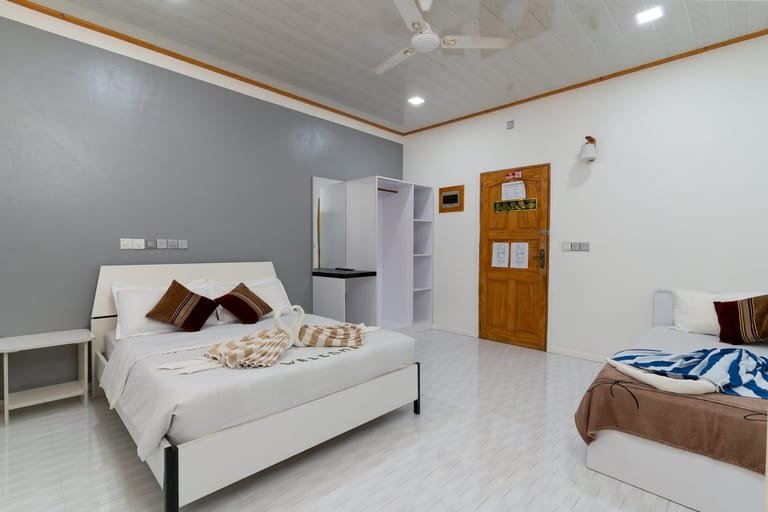
A homestay in the Maldives is a private home that a family rents out to travellers. You get the whole house or a self-contained part of it. A guesthouse is a small commercial property with individual rooms that operate like a budget hotel. Both exist on local islands like Ukulhas, and both show up on Booking.com and Airbnb. The terms overlap a lot in practice, but the experience is different.
This guide explains what each option actually gives you. We cover privacy, shared spaces, meals, kitchen access, laundry, booking style, and who each option suits best. If you are planning a trip to Ukulhas or any local island in the Maldives, this will help you choose.
What “homestay” means in the Maldives
In the Maldives, a homestay is a private residence. A local family owns the house and rents it to visitors. The family may live next door or on another floor, but the space you use is yours. You have your own living room, kitchen, and bedrooms. The host is available if you need something, but they do not run a front desk.
Homestays on local islands like Ukulhas tend to be family-owned houses built for the owner’s own use. They are furnished for daily living, not designed as a commercial property. You will find a real kitchen with pots and pans, a dining table, and a living area. The feel is closer to staying at someone’s house than checking into a hotel.
What “guesthouse” means in the Maldives
A guesthouse in the Maldives is a small commercial accommodation. It typically has between three and fifteen rooms. Each room has a private or shared bathroom. There is a reception area, and staff handle check-in, cleaning, and basic services. Some guesthouses include breakfast. Others have a restaurant or a shared kitchen.
Guesthouses operate like small hotels. You book a room, not a home. The building was designed and built for commercial use. Rooms are standardised. Common areas may include a lounge, a rooftop terrace, or a dive shop counter. On Ukulhas, guesthouses range from basic rooms to well-furnished properties with modern amenities.
The word “guesthouse” on Booking.com and Airbnb sometimes covers homestays too. Platforms do not draw a sharp line between the two categories. A listing labelled “guesthouse” might be a private home. Always read the description to understand what you are actually booking.
How the terms overlap on booking platforms
Booking.com, Airbnb, and travel blogs use “homestay,” “guesthouse,” and “holiday home” loosely. On Booking.com, the property type filter includes “guesthouse” as a category, but many entire homes also appear under that label. Airbnb uses “entire place” versus “private room,” which is a more useful distinction.
When you search for a Maldives homestay, you will see a mix of private homes and guesthouse rooms. The listing title might say “homestay” when it is really a guesthouse room. Or it might say “guesthouse” when it is a full private home. Read the details. Check whether you are booking an entire place or a single room.
The most reliable way to tell is to look at the listing description. Does it mention a private kitchen, a living room, and multiple bedrooms? That is an entire home. Does it describe a room with a bathroom and mention shared facilities? That is closer to a guesthouse model.
Privacy
A homestay gives you the entire home. Your group has the place to yourselves. Nobody else is staying in the other rooms. You come and go as you please. You use the living room, kitchen, and outdoor areas without sharing them with strangers.
A guesthouse room gives you one room and a bathroom. The corridors, lounge, and sometimes the dining area are shared with other guests. You may hear the couple next door through the wall. Your privacy is limited to your room.
For travellers who want space and quiet, an entire homestay is the stronger choice. For travellers who only need a bed and do not mind shared spaces, a guesthouse room works fine.
Shared spaces
In a homestay, the shared spaces belong to your group. The living room is where your family sits in the evening. The kitchen is where you cook your meals. The patio or balcony is where you have your coffee. You do not share these with other guests.
In a guesthouse, shared spaces are communal. The lounge might have three other guests watching television. The dining area might be full at breakfast time. Some guesthouses have a rooftop terrace that all guests use. These spaces are designed for turnover, not for settling in.
On Ukulhas, the island itself is the shared space. The beach, the shops, and the restaurants are a short walk from most properties. You spend much of your time outside the building regardless. The question is what you want when you come back.
Services
A homestay host provides support, not a service menu. Nasir, the host at Maafolhey Han’dhaan, meets guests at the harbour, shows them the home, and is available on WhatsApp for questions. He can help arrange snorkelling trips, recommend restaurants, and coordinate transfers. He does not run a front desk or offer scheduled activities.
A guesthouse has staff on site. Someone is at reception during the day. Housekeeping cleans rooms daily or on request. Some guesthouses offer a tour desk, a laundry service, or airport transfer coordination. The level of service varies by property.
The trade-off is straightforward. A guesthouse gives you more structured services. A homestay gives you more independence and a personal connection with the host.
Meals and kitchen access
This is one of the biggest practical differences.
A homestay has a full kitchen. At Maafolhey Han’dhaan, the kitchen includes a stove, microwave, refrigerator, cookware, cutlery, and a dining table. You can cook any meal. You can make breakfast at 6 AM for an early snorkelling trip. You can prepare food for an infant. You can pack a lunch for a beach day. Learn more about what is in the kitchen at Maafolhey Han’dhaan.
A guesthouse may or may not have a kitchen for guests. Some provide a shared kitchen. Others have a restaurant on site. Many offer breakfast included in the room rate. But you usually cannot cook your own meals in your room. If the restaurant is closed or full, your options are limited.
For travellers who want control over what they eat and when they eat it, a homestay with a kitchen is the clear advantage. This matters especially for families with children, people with dietary requirements, and anyone staying more than a few nights.
Laundry
A homestay typically has a washing machine. Maafolhey Han’dhaan includes a washing machine for guests. You can do laundry during your stay, which means you can pack lighter and wash clothes when you need to.
A guesthouse usually does not have guest laundry. Some offer a laundry service where they wash your clothes for a fee. Others have no laundry option at all. On a longer stay, this becomes inconvenient. You either pack enough clothes for the entire trip or find a local laundry shop on the island.
For families with young children, laundry access is not a luxury. Spills, sand, and sweat happen daily. A washing machine solves the problem without leaving the house.
Booking style
Homestays on local islands are often booked directly through WhatsApp. You message the host, agree on dates and price, and arrive. Some homestays also list on Booking.com or Airbnb for visibility. Booking directly can mean a lower price because there is no platform commission.
Guesthouses almost always list on Booking.com, Agoda, or Airbnb. You select a room, pick your dates, and pay through the platform. Some guesthouses also accept direct bookings. The process is familiar and standardised.
Both models work. Direct WhatsApp booking gives you a personal connection before you arrive, so you can ask questions and get quick answers. Platform booking gives you the structure of a cancellation policy and verified reviews.
If you want to book Maafolhey Han’dhaan directly, you can send a message on WhatsApp.
Homestay vs guesthouse at a glance
| Feature | Homestay (entire home) | Guesthouse room |
|---|---|---|
| Privacy | Entire home to your group | One room, shared common areas |
| Bedrooms | Multiple (2 at Maafolhey Han’dhaan) | Usually 1 |
| Living room | Private, for your group | Shared lounge or none |
| Kitchen | Full private kitchen | Shared kitchen or none |
| Laundry | Washing machine included | Laundry service or none |
| Bathroom | Private, en-suite | Private or shared |
| Host interaction | Personal, via WhatsApp | Front desk or reception |
| Cleaning | Between guests or on request | Daily housekeeping |
| Meals | Self-catering, your schedule | Restaurant or included breakfast |
| Booking | Direct WhatsApp or platform | Platform listing or direct |
| Best for | Families, groups, longer stays | Solo travellers, short stays, couples |
Who each option suits
A homestay (entire private home) suits you if:
- You are travelling with family or a group of friends
- You want a kitchen to cook your own meals
- You value having the place to yourselves
- You are staying four nights or longer
- You have children who need space, routine meals, and laundry
- You prefer a personal connection with a local host
A guesthouse room suits you if:
- You are travelling solo or as a couple
- You only need a room to sleep in
- You prefer daily housekeeping and a front desk
- You are staying one to three nights
- You do not mind sharing common areas with other guests
- You want a simple booking through a platform
Maafolhey Han’dhaan is an entire private vacation home on Ukulhas island: two bedrooms, two bathrooms, a full kitchen, a washing machine, and a private patio, with space for up to six people. If you want the independence of a home rather than a hotel room, take a look at the property page or send a message on WhatsApp to check availability.