Most Maldives fishing content sells you a boat or a liveaboard. Very little of it helps you decide what kind of trip you are actually planning, which is the decision everything else follows from.
This is the planning guide. What is targeted here, what the three main techniques ask of you, how a fishing day tends to run, how many days to allow, and what Ukulhas works as and does not. It deliberately contains no law and no accommodation argument, because both are their own subject: the rules are covered separately, and so is how a group of four to six actually lives during the trip.
One boundary before anything else. We rent a house on Ukulhas. We do not run fishing trips, we have no partnership with any operator, and nothing below is a promise about what you will catch. Anyone who promises you that is selling something.
What is actually targeted from here?
Giant trevally is what much of the Maldives popping and jigging content is built around, and it is not the only thing worth planning around.
Operators working out of Ukulhas advertise giant trevally, yellowfin tuna and wahoo as their principal targets, with dogtooth tuna a realistic prospect on deeper marks. Local listings also mention billfish, though that is a different kind of day and a different kind of trip.
What none of that tells you is what you will catch, and no honest page will. Fish are wild, conditions decide a great deal, and a week can be exceptional or flat for reasons nobody controls. Plan around the fishing you want to do rather than a species you intend to land, and treat any operator who guarantees an outcome with suspicion.
On species you may not take, which is not optional reading: sharks, rays, whale sharks, Napoleon wrasse and parrotfish are all protected under Maldivian fisheries regulation, and the law amending that regime was revised on 31 August 2026. Giant trevally is on neither protected list, so release is operator policy rather than law. The rules guide covers this properly.
Popping, jigging or trolling: which trip are you planning?
They are three different days, and a group that has not agreed which it wants will get a compromise.
Popping is surface work: heavy spinning tackle, large stickbaits and poppers cast at structure and worked back hard. It is physically demanding, it is what most GT-focused anglers travel for, and it rewards a boat that will sit on a mark and let you cast repeatedly rather than moving on.
Jigging is vertical: heavy metal jigs worked from depth, usually over pinnacles and drop-offs. It is equally tiring in a different way, it puts you in contact with dogtooth and amberjack water, and it depends far more on the skipper's ability to hold position over a specific structure.
Trolling covers water rather than structure, with lures run behind a moving boat. It is the least demanding on the angler, it is how most mixed groups fill a day, and it is what a boat will default to when conditions rule out the other two.
Most Ukulhas operators list all three. That is normal, and it means the day you get depends on what you ask for and on the weather. If your group has one popping specialist and three people who would rather troll, decide that on land.
What does a fishing day tend to look like?
Early, long and weather-dependent.
Boats leave before or around first light. Trips published for Ukulhas in August 2026 ranged from short two-hour outings to full days of eleven hours, so the shape of the day is something you choose rather than something fixed. A full day usually means a packed lunch on board and a return in the afternoon, at a time nobody can predict precisely.
Night fishing is offered from the island as a standard excursion and is a genuinely different trip rather than an extension of the day one.
What decides all of it is sea conditions. A skipper may cancel or change the plan, so build flexibility into the itinerary rather than fixing your fishing days in advance. That is not a failure of the operator; it is what fishing from a small boat in open water means.
How many fishing days should you allow?
More than you think, and fewer than you can physically manage.
Two considerations pull against each other. Conditions will cost you days, so a trip with only two fishing days planned can end up with one. Meanwhile popping and jigging are genuinely hard work, and few anglers do either at full effort for six consecutive days without their casting deteriorating.
A reasonable shape for a seven-night trip is four fishing days with flexibility about which four. For ten to fourteen nights, six to eight fishing days with deliberate rest and maintenance days between them. Book the boat around that rather than fishing every available day and burning out by day four.
This is also the argument for a longer trip rather than an intense short one. A week with four fishing days absorbs one cancellation. A four-night trip with three fishing days does not.
How does group size change the plan?
A group of six is close to a whole boat, and that changes the economics and the fishing.
Charter listings for Ukulhas seen in August 2026 showed boats of around twenty-seven to thirty-five feet taking five to six passengers. Operator fleets change, so confirm with the operator directly. So a group of six is not sharing with strangers, it is effectively chartering. That is good for control over the plan and it means the cost is divided by six rather than paid per head at a shared rate.
It is less good for casting room. Six anglers popping from a thirty-foot boat is crowded, and most groups of six naturally rotate: three or four fishing while the others rest, shoot video or re-rig. Decide that rotation before you are on the water and it is a system; discover it on the water and it is an argument.
Ask any operator directly how many rods they will fish at once, because that answer shapes the day more than boat length does.
What tackle should you plan around?
Bring what you need and expect to replace nothing.
The research behind this guide found no tackle shop named on Ukulhas in any language, which is a strong signal in itself. Assume you are bringing everything: rods, reels, main line and leader, terminal tackle, and more poppers and jigs than feel reasonable, because losing them to structure and to fish is the normal course of a GT trip.
Some Ukulhas operators do rent rods and reels by the day, which is a sensible fallback for a broken rod or for a non-specialist joining a group, but it is not a plan for a dedicated popping trip.
Two practical points. Rod tubes are the awkward item, on the flight and on the speedboat transfer, so tell your transfer provider what you are bringing and confirm handling in advance. And spear guns and harpoon guns are restricted imports requiring a permit from the Ministry of Defence and National Security; rods, reels and lures are not restricted.
When should you go?
Choose your months around conditions rather than around a species calendar.
The Maldives has two monsoon periods. The Maldives Meteorological Service describes the wetter southwest monsoon as running roughly from mid-May to November, the drier northeast monsoon from January to March, with December and April as transitional. Sea state follows broadly from that, and sea state is what determines whether your boat goes out.
This guide does not publish a species calendar, and you should be wary of ones that do. Seasonal claims about what is running when are the single most confidently asserted and least well sourced thing in Maldives fishing content. Ask the operators you are considering what the last few seasons have actually been like, and weight their answer by how willing they are to say "it varies".
Ukulhas is also at its busiest from December through March, which overlaps the drier months. Quieter and cheaper is May to November, at the cost of more variable conditions.
What does Ukulhas work as, and what does it not?
It works as an independent, land-based option in North Ari. It does not work as a package.
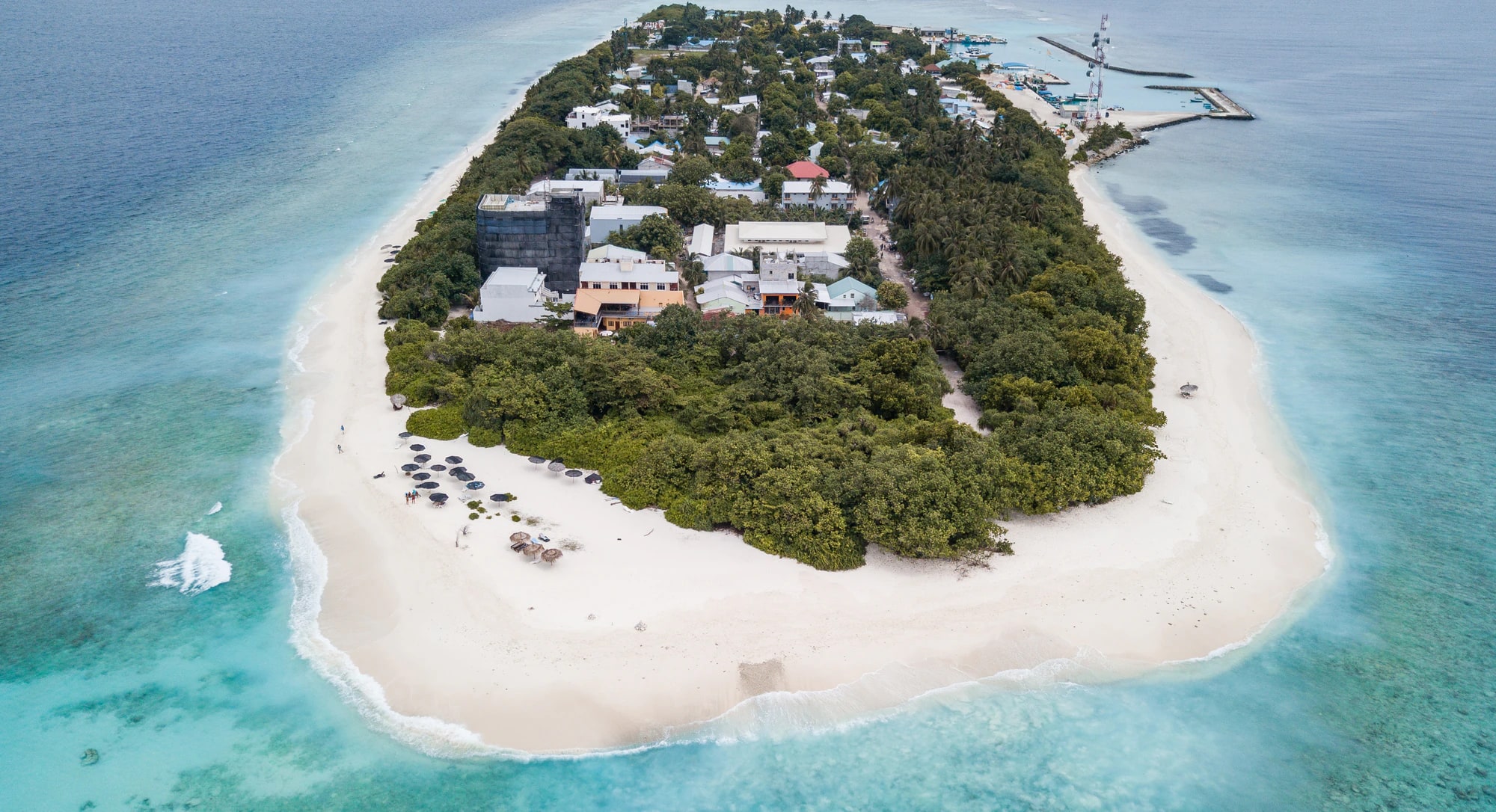
Ukulhas is an inhabited local island in Alif Alif, about one kilometre long, with a harbour, shops, restaurants and its own dive and fishing operators. Several charter boats work from it, and it is close enough to North Ari's atoll-edge structure to make day trips workable rather than expeditionary.
The honest limits. There are two main fishing providers here, so your choice is narrower than in Malé, where dozens of charters operate. Fishing is prohibited in five designated protected areas within Alif Alif, which is worth knowing before a skipper names a mark. There is no alcohol on inhabited local islands. And a land base means you fish the water you can reach in a day, where a liveaboard moves to the fish.
Against that: you are not locked to a boat's itinerary, you choose your own fishing days, non-fishing partners have an island rather than a deck, and your costs are separable rather than bundled into a package price.
What should you settle before you book anything?
In this order.
- Which technique the trip is really about, agreed by the whole group.
- How many fishing days, with flexibility built in for weather.
- The operator, checked on credentials, boat, how many rods they fish at once, and what happens when a trip is cancelled.
- The marks they intend to fish, against the five protected areas in Alif Alif.
- What you are bringing, assuming no local replacement.
- The land base, once you know how many of you there are and how long you are staying.
That last one is a bigger decision than most groups expect. Our guide to a seven to fourteen night trip for four to six anglers, linked above, covers what the accommodation actually has to do between fishing days, which is where a group trip is either comfortable or difficult.
If a whole private home suits your group, see the house and send your dates, group size and what you are planning to fish. We will put you in touch with the island's operators; the fishing arrangement is between you and them.