For a fishing group, the question is not only how many beds the accommodation provides. It is whether the property works as a practical base before and after a day at sea.
That distinction gets missed because accommodation is usually chosen the way a holidaymaker chooses it, on rooms and rates. A serious angling group is doing something different. They are running an operation out of a building for a week or two, on a schedule that has nothing to do with hotel hours, with a large volume of expensive equipment that has to be prepared, dried, stored and prepared again.
This guide covers what that actually requires. For what Maldivian law permits, which species are protected and where fishing is prohibited in North Ari, our guide to the rules covers it separately, and you should read it before you book anything.
A fishing trip runs on a different schedule
Almost nothing about a fishing day matches the rhythm accommodation is designed around.
You wake before sunrise. Tackle and personal gear get a final check in the dark. You eat before any restaurant is open and well before a guesthouse serves breakfast. You leave for the harbour before first light. And you come back at a time nobody can predict, because it depends on the fishing and on the weather rather than on a plan.
Every one of those points collides with a serviced arrangement. Half board is built around fixed meal times. A guesthouse breakfast at seven is three hours too late for a boat that leaves at four. Returning at an unpredictable hour means arriving after the kitchen has closed, more often than not.
None of this is a complaint about guesthouses, which are set up perfectly sensibly for the guests they usually have. It is simply that an angling group is not that guest, and the mismatch compounds over ten or fourteen days.
Six anglers bring far more than six suitcases
This is the thing organisers underestimate, and it is worth listing properly.
A group of six arrives with rod tubes, reels, tackle boxes, trays of poppers and jigs, leader and terminal tackle, fishing clothing, dry bags, cameras and action cameras, chargers and spare batteries, and then their ordinary luggage on top of all of it.
Three hotel rooms provide six beds. What they do not necessarily provide is anywhere to lay that out. Rigging a rod, sorting jigs into trays or re-spooling a reel needs a flat surface, decent light and space that nobody needs back in twenty minutes. In a bedroom, gear ends up on a bed and then has to come off the bed before anyone sleeps, every single day.
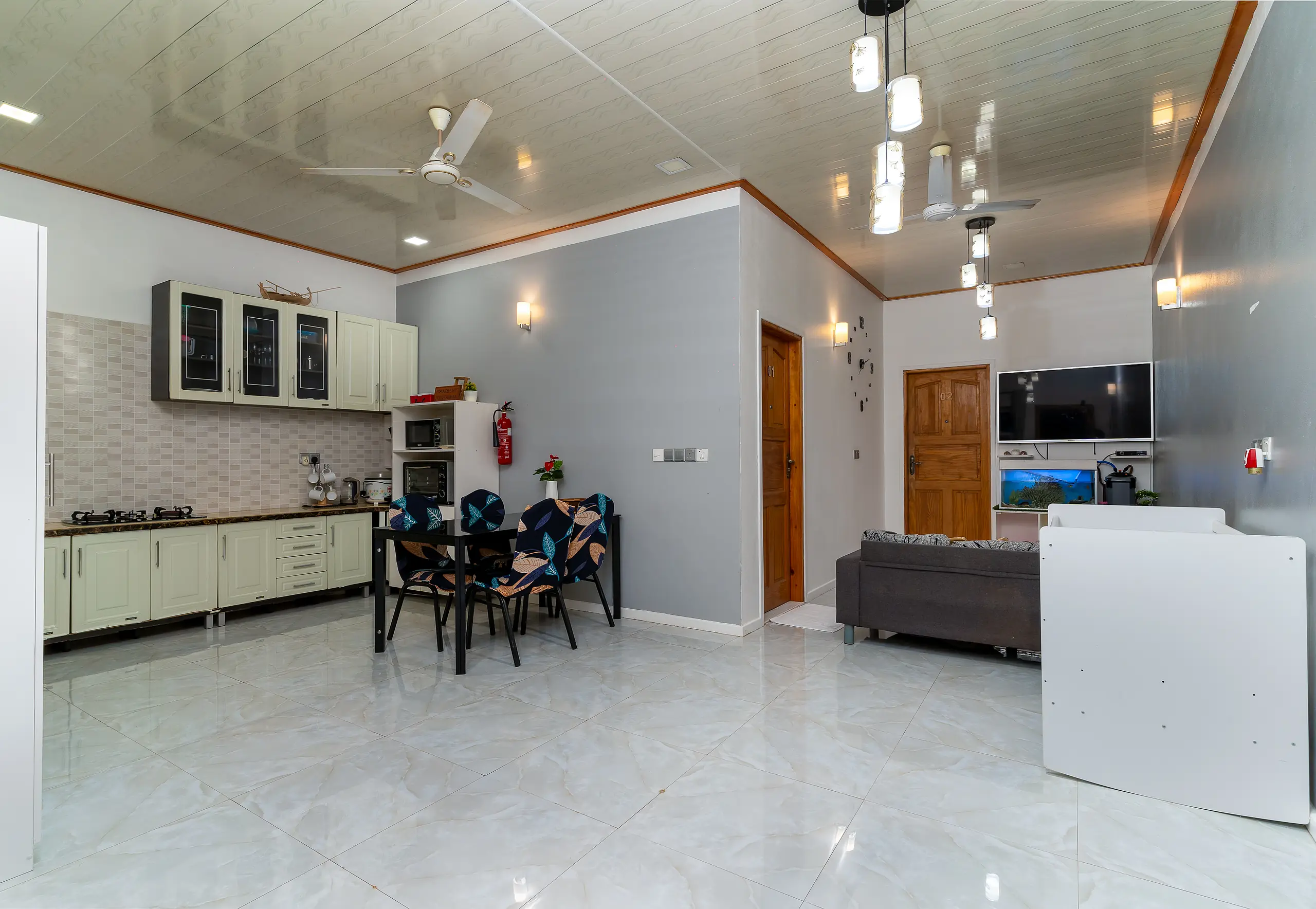
At Maafolhey there is space in the living room for rod tubes and long hard cases, within reach on the way out rather than buried in a wardrobe. The dining table is a working surface. And the house locks as a whole with the group holding the keys, so twenty thousand dollars of tackle stays inside while everyone is on the water, without anything being carried in and out of separate rooms each day.
Wet gear has to go somewhere
Almost nobody writes about this, and over a fortnight it becomes one of the defining features of the trip.
You come back with wet shirts and shorts, towels that need drying, and equipment carrying salt. Clothing needs washing far more often than on a normal holiday. And none of it can simply sit in a pile inside a bedroom for two weeks.
What Maafolhey has: a washing machine for salt-soaked and sandy clothing, a portable clothes hanger in the living room that wheels out into the courtyard to dry in the sun, and an outdoor tap in the courtyard that guests may use for rinsing, in an area that drains well.
What it does not have, and we would rather say so: a dedicated gear room, a rinse tank, or drying racks built for the purpose. It is a house with a machine, a tap and somewhere to hang things, not a fishing lodge. For six people over ten days that turns out to be enough, but you should know exactly what you are getting.
Food when anglers actually need it
This is a stronger argument than "there is a private kitchen", because the value is in the timing rather than the appliance.
An angler wakes at four and is hungry. Another wants coffee before departure. Someone comes off the water at three in the afternoon having eaten a packed lunch at six in the morning, and wants food immediately rather than waiting for a restaurant to open.
The whole home belongs to your group, including the kitchen and the front door, at any hour. There is no arrangement to make and nobody to ask. Over one night that is a convenience. Over ten or fourteen, with a group whose hunger is dictated by tides rather than clocks, it is operational.
The kitchen has a stove, an oven and a refrigerator with a freezer. Guests are welcome to store their catch in the freezer and cook it. The self-catering guide covers what the kitchen holds and how the island's shops work.
The group needs somewhere to operate together
The evening before a fishing day is a working session, whether anyone calls it that or not.
You look at the weather. You decide the target and the marks. Rods get rigged, lures sorted, cameras charged, and departure time agreed. This is a large part of what makes a group trip a group trip, and it is difficult to do when the party is split across three bedrooms in a building with no shared space of its own.
Maafolhey has an air-conditioned living and dining area separate from both bedrooms, and a small courtyard with a table, chairs and an umbrella opening off it. It is somewhere the whole group can sit around one table with tackle spread across it, which is not a luxury on a fishing trip so much as the room where the trip gets planned.
What does it cost, and what are you comparing?
Here is the arithmetic, with the assumptions stated, because a range presented as a fact is worse than no range at all.
Working from a planning assumption of USD 60 to 85 per double room per night on a bed-and-breakfast basis, with six anglers in three double rooms:
| Nights | Three rooms at USD 60 | Three rooms at USD 85 |
|---|---|---|
| 7 | USD 1,260 | USD 1,785 |
| 10 | USD 1,800 | USD 2,550 |
| 14 | USD 2,520 | USD 3,570 |
Read those as planning assumptions and nothing more. They are not market averages, they are not quotes, and they are not stable. Current listings for Ukulhas rooms have been observed both below and well above that band, with breakfast-inclusive rates over USD 100 and direct seasonal offers higher again. Tax and service-charge treatment varies between listings, so a headline rate may or may not include the 17% TGST and the service charge, and Green Tax is generally separate. Get real quotes for your exact dates and check what is inside each one.
Price alone does not determine which option is better. The useful comparison is what six anglers receive for the total accommodation spend. Three rooms buy six beds, breakfast at a fixed time and daily housekeeping. One whole home buys the beds plus a kitchen you control, a living area to work in, laundry, exclusive use of the building, one set of keys and one bill. Those are different products, and which is better value depends entirely on whether your group will use the second list.
For a proper household cost method, including how to compare food across accommodation types over a longer stay, our long-stay cost guide sets out the arithmetic with its assumptions stated.
Weather days and rest days are part of the plan
Over seven to fourteen days you will not fish every day, and this is where the two options separate most sharply.
Sea conditions cancel trips. Groups take a recovery morning after a hard day. Equipment needs maintenance, reels need attention, somebody has to re-tie everything. And on a longer trip there is usually at least one day nobody wants to get on a boat.
A weather day in a hotel room is a long day. A weather day in a house with a kitchen, a living area, a courtyard and somewhere to work on tackle is just an indoor day. Since these days are certain to happen and impossible to schedule, they belong in the accommodation decision rather than being treated as bad luck.
When guesthouse rooms are the better choice
Frequently, and it would be dishonest to pretend otherwise.
Rooms make more sense when the group is two or three people rather than six; when you are not carrying much equipment; when you would rather breakfast and housekeeping were simply handled; when nobody intends to cook; or when you want the services that come with a serviced property. Ukulhas guesthouses do this well, and for a short trip with light tackle they are the straightforward choice.
The whole-home argument in this guide is narrow. It applies to groups large enough to fill a house, carrying enough equipment to need somewhere to put it, on a schedule that does not fit service hours. Outside that, rooms are often better and usually simpler.
When a whole private home makes more sense
When most of the following are true at once.
Four to six anglers travelling together. Several fishing days rather than one or two. Enough equipment that it needs its own space. Departures before dawn and returns at unpredictable hours. A preference for eating on your own timing, including cooking the catch. Laundry that will run most days. And a wish to plan tomorrow around one table rather than in three separate rooms.
Maafolhey is one entire two-bedroom home on Ukulhas, rented to one group at a time, sleeping up to six. Bedroom one has one double bed; bedroom two has one queen and one single; a sixth guest takes the living-room sofa or an extra mattress on request. Both bedrooms are air-conditioned with their own bathroom. For a six-man group, be honest with yourselves about that configuration before you book: it works well for four to five, and six means somebody is on the sofa.
We do not run fishing trips and we hold no partnership with any operator. Ukulhas has two main fishing providers and groups book directly with one of them; we can make introductions and calls on your behalf.
See the house and its spaces, then send your dates, group size and what you are planning to fish.