A USD 60 double room can look cheaper than a private home until a group of four needs two rooms, or a group of six needs three. Add meals for every person across 30 or 60 nights, and the nightly room price no longer describes the household budget.
The useful comparison is total accommodation plus food for the whole group, calculated over the same dates and then divided by the number of guests. Taxes, transfers and activities should also be checked, but kept visible as separate lines where they apply to both options.
Why is the nightly room price only part of a long-stay budget?
A fair long-stay comparison starts with the number of rooms, not the cheapest rate shown for one room.
Use this basic calculation:
(rooms × nightly room rate × nights) + household food cost = comparable accommodation-and-food total
For transparent examples, this guide assumes two guests per double room:
| Group size | Illustrative room requirement |
|---|---|
| 2 guests | 1 double room |
| 4 guests | 2 double rooms |
| 6 guests | 3 double rooms |
Actual occupancy rules vary by property. A family room, extra bed or suite may change the room count, while some properties will not allow the same arrangement. Compare an actual quote for your guest ages and room configuration rather than assuming a universal policy. The hotel-room versus private-home guide covers the accommodation setup itself; this article concentrates on the cost that accumulates over time.
Are USD 50–80 room assumptions realistic for Ukulhas?
USD 50–80 per double room per night remains useful as a lower-market planning range, but it is not a universal Ukulhas average. The USD 50 point should be treated as a low-end sensitivity test. Current checks on 26 August 2026 found discounted Ukulhas double-room listings around USD 65–83 per night before some statutory charges, a direct room-only offer at USD 75 with its tax basis unstated, and other breakfast-inclusive rates at USD 100 or more.
Stronger and peak-period evidence also exceeded USD 100. One current direct Ukulhas offer published room rates of USD 100, USD 150 and USD 200 for two guests across value, regular and peak seasons, inclusive of applicable taxes and service charges. Dates, property, room type, occupancy, cancellation terms and meal plan can all change the quote. USD 100 is therefore a comparison point, not a ceiling.
Before using any headline rate, establish:
- whether it is for one room or the whole group;
- whether breakfast or another meal plan is included;
- whether service charge, 17% TGST and Green Tax are included or added later;
- whether the displayed rate depends on a member discount, promotion or non-refundable condition.
What can restaurant-heavy dining cost?
For planning purposes, a simple restaurant-heavy scenario using USD 7 for breakfast and USD 15 each for lunch and dinner equals about USD 37 per person per day.
USD 7 + USD 15 + USD 15 = USD 37 per person per day
This is a planning assumption, not a fixed Ukulhas average. A current Ukulhas menu check found light breakfast plates at USD 5–9, full breakfast sets at USD 15–22 and many lunch or dinner dishes at USD 7–15, before that restaurant's stated 10% service charge and 8% GST. Another current accommodation listing quoted breakfast at USD 10. The USD 37 model is therefore plausible for simple choices, but a full breakfast, drinks, larger seafood dishes, taxes and service can take the total higher.
For a group, restaurant costs generally scale per diner and per meal. Under the USD 37 assumption:
- four guests cost USD 148 per day, or USD 8,880 over 60 days;
- six guests cost USD 222 per day, or USD 13,320 over 60 days.
If breakfast is included in the room rate, do not add USD 7 again. If half board or full board is quoted, use the actual meal-plan supplement instead of the restaurant-heavy model.
Why does grocery spending behave differently?
Household grocery spending includes an initial setup and later top-ups. It should not be modelled as if the group starts a new USD 50–100 basket every morning.
Early purchases may include rice, cooking oil, spices, salt, sauces, flour, pasta, coffee, tea and condiments. Some of those items last across many meals. Later shopping may concentrate more on bread, milk, eggs, fruit, vegetables, fish or meat, drinking water and other perishables. The exact mix depends on the household and current stock.
This creates a first-week effect: week one may cost more because the kitchen is being stocked, while later weeks may involve top-ups rather than buying every staple again. There is no defensible fixed percentage reduction.
Restaurant spending usually increases one diner and one meal at a time. Grocery spending also rises with group size, but shared ingredients can be spread across several plates and several days. That does not guarantee a particular economy of scale; it is why a weekly household basket is a better planning unit than an invented daily grocery allowance.
Ukulhas has local marts and grocery purchasing is possible. Current national tools also track everyday food prices across the Maldives. Neither source supplies a complete, stable Ukulhas weekly basket, so the figures below are illustrations rather than claims about what a household will spend on the island. The Ukulhas self-catering guide explains what to verify before relying on the kitchen.
How do you calculate groceries per person per day?
Use one formula:
weekly grocery basket ÷ 7 ÷ number of guests = approximate grocery cost per person per day
For example:
USD 300 ÷ 7 ÷ 4 = approximately USD 10.71 per person per day
The following are illustrative household planning scenarios, not current Ukulhas price averages:
| Household | Weekly basket | Household per day | Per person per day |
|---|---|---|---|
| 4 people | USD 250 | USD 35.71 | USD 8.93 |
| 4 people | USD 300 | USD 42.86 | USD 10.71 |
| 4 people | USD 350 | USD 50.00 | USD 12.50 |
| 6 people | USD 300 | USD 42.86 | USD 7.14 |
| 6 people | USD 400 | USD 57.14 | USD 9.52 |
| 6 people | USD 450 | USD 64.29 | USD 10.71 |
Build a basket around what your group will actually eat. Imported or specialist products, dietary requirements, drinks and frequent premium proteins can change it substantially.
Should a long-stay food budget assume cooking every meal?
No. A useful comparison tests three food patterns rather than treating self-catering as an obligation.
- Mostly self-catering: most meals are prepared in the accommodation, with restaurant spending added separately.
- Mixed approach: groceries cover selected meals and snacks, while the group chooses some restaurant meals.
- Restaurant-heavy: most meals are bought outside, using an actual meal plan or a per-person dining allowance.
The mixed model may be the most useful one to calculate because it shows the effect of both groceries and selected meals out. It is not a claim about how Maafolhey guests behave.
What does the comparison look like for four guests over 60 nights?
Using Maafolhey's 60-night product, four guests have an accommodation cost of USD 31.25 per person per day. The USD 7,500 accommodation total includes service charge and TGST; Green Tax and transfers remain separate.
USD 7,500 ÷ 60 ÷ 4 = USD 31.25
Add the illustrative USD 300 weekly grocery basket:
USD 300 ÷ 7 ÷ 4 = USD 10.71 per person per day
The combined accommodation-and-grocery result is approximately USD 41.96 per person per day. Across 60 nights, groceries are approximately USD 2,571 and the household total is approximately USD 10,071.
Here is the same period compared with two double rooms and the USD 37 restaurant-heavy food assumption:
For the sensitivity tables, USD 50, USD 80 and USD 100 are inserted as the complete room amounts used in the arithmetic, and USD 37 is the complete food amount used. No extra TGST or service charge is added to those illustrative rows. If an actual quote excludes either charge, add it before comparing the result with Maafolhey's tax-inclusive accommodation total. Green Tax and transfers remain outside every row.
| Four-person scenario | Accommodation pp/day | Food pp/day | Combined pp/day | 60-night household total |
|---|---|---|---|---|
| Maafolhey + USD 300/week groceries | USD 31.25 | USD 10.71 | USD 41.96 | USD 10,071 |
| 2 rooms at USD 50 + restaurant-heavy food | USD 25.00 | USD 37.00 | USD 62.00 | USD 14,880 |
| 2 rooms at USD 80 + restaurant-heavy food | USD 40.00 | USD 37.00 | USD 77.00 | USD 18,480 |
| 2 rooms at USD 100 + restaurant-heavy food | USD 50.00 | USD 37.00 | USD 87.00 | USD 20,880 |
These are illustrative scenarios, not guaranteed savings. The room figures are planning assumptions; the guesthouse rows do not include a breakfast credit or meal-plan adjustment. Actual totals depend on room rates, included meals, taxes, grocery choices and dining habits.
What does the comparison look like for six guests?
With six guests, the same USD 7,500 accommodation total becomes approximately USD 20.83 per person per day:
USD 7,500 ÷ 60 ÷ 6 = USD 20.83
Add the illustrative USD 400 weekly grocery basket:
USD 400 ÷ 7 ÷ 6 = USD 9.52 per person per day
The combined result is approximately USD 30.36 per person per day. Across 60 nights, the grocery scenario is approximately USD 3,429 and the household total is approximately USD 10,929.
| Six-person scenario | Accommodation pp/day | Food pp/day | Combined pp/day | 60-night household total |
|---|---|---|---|---|
| Maafolhey + USD 400/week groceries | USD 20.83 | USD 9.52 | USD 30.36 | USD 10,929 |
| 3 rooms at USD 50 + restaurant-heavy food | USD 25.00 | USD 37.00 | USD 62.00 | USD 22,320 |
| 3 rooms at USD 80 + restaurant-heavy food | USD 40.00 | USD 37.00 | USD 77.00 | USD 27,720 |
| 3 rooms at USD 100 + restaurant-heavy food | USD 50.00 | USD 37.00 | USD 87.00 | USD 31,320 |
Again, the calculation demonstrates what happens under the stated assumptions. It does not promise that one booking will be cheaper than every real guesthouse or hotel quote.
What changes between 30 and 60 nights?
The method does not change; the consequences compound. At 30 nights, multiply the room count and daily food model across 30 days. At 60 nights, use 60. One-time pantry purchases also become spread across more guest-days as the stay lengthens.
Do not pro-rate Maafolhey's 60-night price to a 30- or 45-night stay. The USD 7,500 total is one fixed product for exactly 60 occupied nights. The 60-night guide explains its 50 paid nights, 10 complimentary nights and separate charges. If the duration itself is not settled, compare one week, two weeks and a month-plus first.
How do meal plans change the comparison?
Meal plans can materially change the result. Current Ukulhas evidence includes breakfast-inclusive, half-board and full-board offers, with direct supplements ranging by property and offer. A fair comparison is therefore:
- room-only plus the dining your group expects;
- room plus the actual quoted meal plan;
- whole home plus a mostly self-catering or mixed food budget.
If a guesthouse's full quote includes breakfast, drinking water, taxes or other items, give those inclusions their proper value. Do not compare a tax-exclusive promotional room headline with an all-in accommodation price. Ask for the complete total for every room, every guest and the exact dates.
Which costs should stay outside the headline comparison?
Keep charges outside the accommodation-and-food table when they apply separately or depend on the booking:
- Green Tax: at Maafolhey, USD 6 per taxable guest per night, separate from accommodation. Children under age two at check-in are exempt under the current rule. Check the applicable amount in every competing quote rather than assuming it is included.
- Transfers: compare the same airport-to-island journey and keep transfers separate unless a quoted package explicitly includes them.
- Laundry: include an outside service cost if the accommodation does not provide a washing machine or usable laundry arrangement.
- Drinking water and specialist groceries: confirm what the accommodation or meal plan covers.
- Diving, excursions and personal activities: price these from current operators and keep them out of the food comparison.
- Visa-extension planning and accommodation-specific charges: check these separately where the length of stay makes them relevant.
This prevents either side of the comparison from looking cheaper because a shared or unavoidable cost has been hidden.
Where does Maafolhey fit in this model?
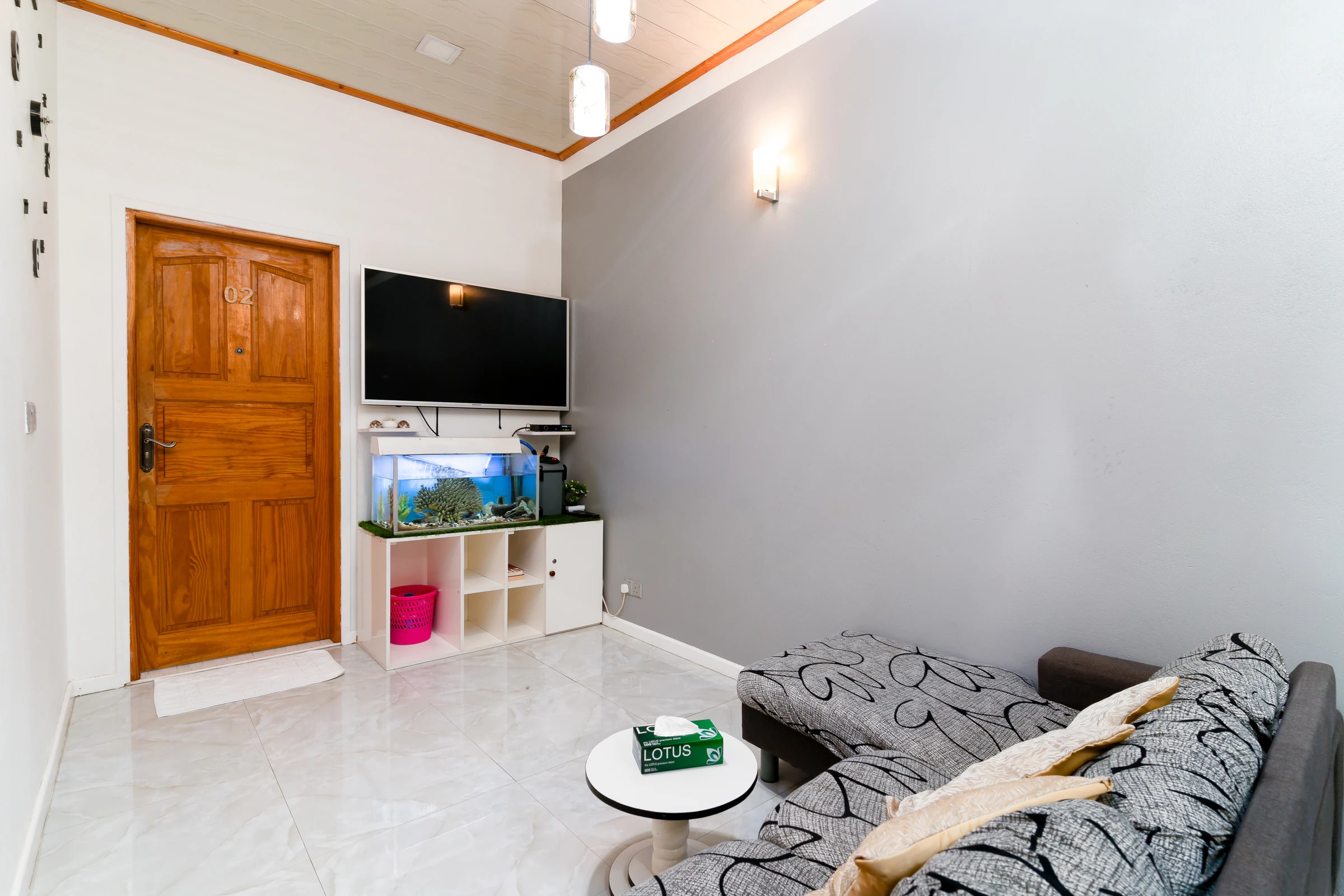
Maafolhey is one whole private two-bedroom holiday home on Ukulhas for up to six guests. The booking includes the private kitchen, living and dining area, washing capability and Wi-Fi. No breakfast or meal plan is included.
Housekeeping is provided throughout the stay. Cleaning and linen changes are available on request; otherwise routine housekeeping is provided every three days.
The 60-night accommodation total is USD 7,500, with Green Tax and scheduled speedboat transfers separate. See the published rates and offers for shorter stays and use actual competing quotes for the same dates, guest count, fee basis and meal arrangement.
When your duration, group size and comparison basis are clear, check your dates and guest details. Maafolhey confirms availability and the final price with you on WhatsApp.