Planning several weeks or months in the Maldives changes which decisions matter most. Food stops being a per-meal treat and becomes a budget line. Laundry becomes a logistics question. Living space, the season you travel in and how the island connects to the airport all carry far more weight than they do over four nights.
This guide covers what actually changes when you plan several weeks or months rather than a short holiday, and how to judge whether a local island can support that kind of stay.
Why local islands can work well for longer Maldives stays
Some travellers staying longer than a typical holiday base themselves on local inhabited islands instead of resorts. The practical reason is what those islands can offer over time: because people live there year-round, many have everyday services such as shops and restaurants. What any specific island offers varies, so compare islands individually rather than assuming services exist everywhere.
Whether that trade suits you depends on the trip you are planning, which is why it is worth comparing what different accommodation types actually include before committing to several weeks anywhere.
What changes when your stay runs into weeks
Three practical factors behave differently over a long stay, and they should drive your choice of accommodation more than the nightly headline rate.
Food. Restaurant bills that feel normal for five nights become a major budget line by week four. Accommodation with a real kitchen lets you cook most days and eat out when you want to, instead of paying for every meal.
Laundry. Two weeks without laundry means packing for two weeks or paying for washing somewhere. Over a month, access to a washing machine in the property reduces how much clothing a long-stay guest needs to bring.
Space. One room works for a few nights. Weeks in a single room, especially with another person, get cramped. Somewhere to sit apart, cook, eat at a table and close a door matters more on night twenty than night two.
Any island you choose for a long stay should be judged on whether your accommodation supports these three things, not just on its beach.
How to judge a local island for a longer stay
Islands differ more than listings suggest. Before committing to a month somewhere, check:
- Everyday infrastructure. Are there grocery shops? A bakery or café? Several restaurants, so you are not eating the same menu for a month? These exist on some tourist-oriented local islands and are thin or absent on others.
- Beach arrangements. On inhabited local islands, swimwear is permitted only at designated bikini beaches, and modest dress applies in the village. Confirm the island has a designated beach area you can reach comfortably, because you will use it often.
- Activity depth. If you dive or snorkel, check what operates from the island and how often trips run before you book.
- Transfer reality. You will make this journey at least twice, possibly more if friends visit or you take side trips. Allow around 90 minutes for the scheduled speedboat between Velana International Airport and Ukulhas; some services can take longer depending on intermediate stops, weather and sea conditions.
- Community size and layout. Islands vary greatly in population and walkability. Verify any specific figures for the island you are considering rather than relying on generalisations, because after week three these differences shape daily life.
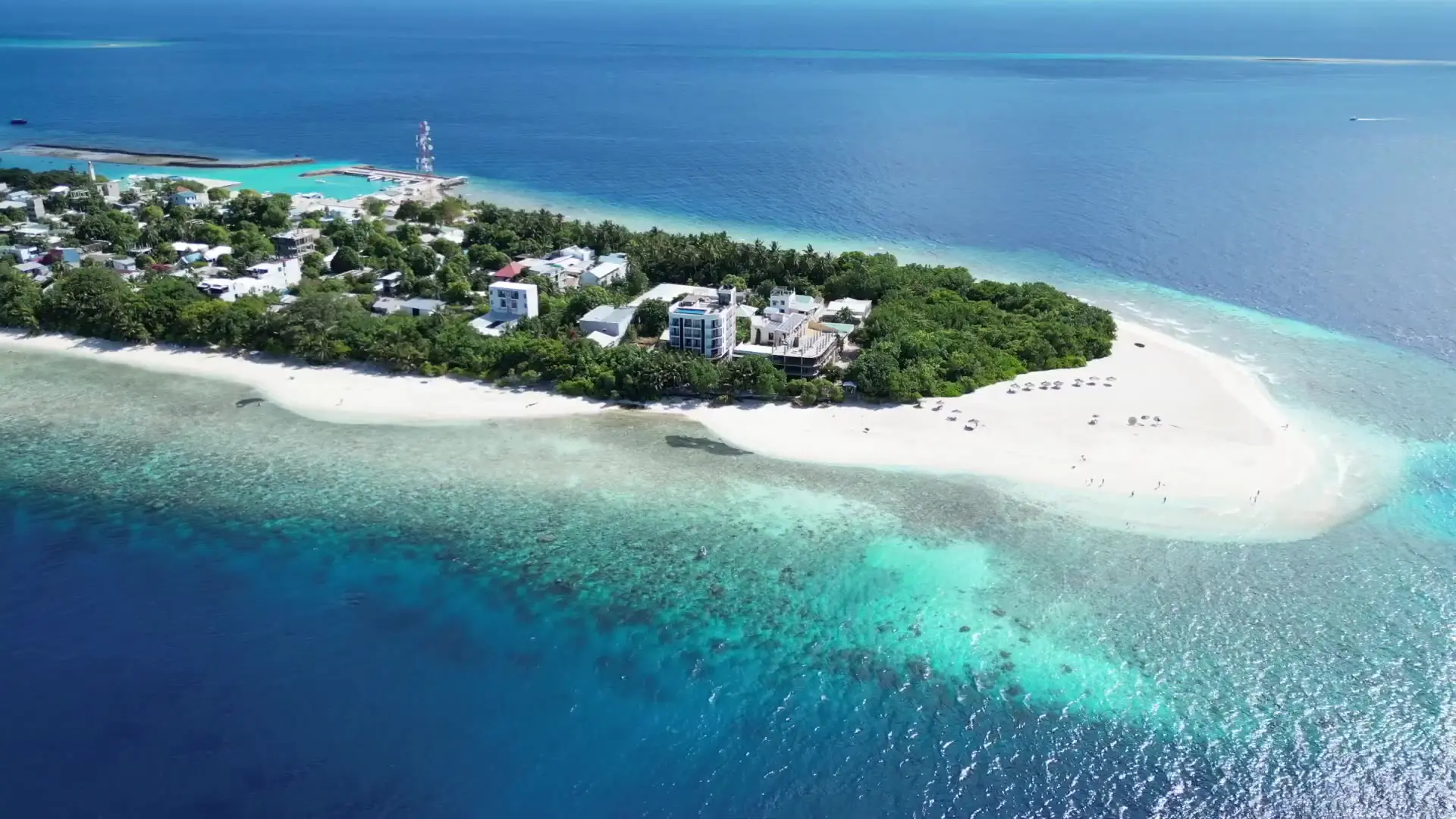
Ukulhas, in Alif Alif Atoll (also called North Ari Atoll), is one example of an island set up for this kind of stay: a working community with shops, bakeries, restaurants and dive operations, plus a designated bikini beach.
Seasons matter more when you stay longer
For a short trip, weather risk is contained: a few wet days are survivable. Over two months, the season you choose shapes the whole experience.
According to the Maldives Meteorological Service, the wetter southwest monsoon runs roughly from mid-May to November, the drier northeast monsoon runs from January to March, and December and April are transitional periods. Maafolhey's seasonal pricing makes the practical spread concrete (rates current at the time of writing; see the rates page for today's figures): the entire private home is USD 150 per night in May, June, July and September; USD 250 per night in April, August, October and November; and USD 400 per night from December through March, with a festive-period override from 24 December to 5 January. Each nightly rate includes the 10% service charge and 17% TGST. Green Tax (USD 6 per taxable guest per night) is charged separately.
A traveller staying 30 nights in June therefore pays USD 4,500 in accommodation where the same 30 nights in March would cost USD 12,000. Both figures are accommodation only: published nightly rates already include the 10% service charge and 17% TGST, while Green Tax and transfers are added separately.
What a month actually costs in accommodation
Worked example, using published rates and stated assumptions: two adults staying the whole of June at Maafolhey pay USD 150 × 30 nights = USD 4,500 for the entire home, which includes the 10% service charge and 17% TGST. Green Tax adds USD 6 per taxable guest per night (USD 360 for two guests across 30 nights). Scheduled speedboat transfers are priced separately.
Complimentary-night offers apply only at their exact stay lengths: Stay 7 · Pay 6, Stay 10 · Pay 8, Stay 14 · Pay 11 and Stay 21 · Pay 17. A 30-night booking does not automatically attract one of these offers; ask about current terms for your exact dates.
Compare any alternative on the same basis: total accommodation for the whole group, then add taxes, transfers and food realistically. Monthly cost figures quoted online vary enormously because some include meals and taxes and some do not. State assumptions, or the comparison means nothing.
Kitchens, laundry and daily life
If your accommodation has a kitchen and washing machine, a long stay on a local island runs like ordinary life in a warm place: shop every couple of days, cook breakfast and perhaps dinner, eat out some evenings, run laundry as it accumulates.
Without a kitchen, every meal over a month becomes a restaurant transaction. With one, you can replace some of those restaurant meals with self-catering and eat out when you choose. How much that changes your total spending depends on how you eat and local ingredient costs, but kitchen access should sit near the top of your selection criteria either way.
How long you are allowed to stay
Immigration rules and accommodation choices are separate questions. What your passport allows is set by Maldives Immigration and depends on your nationality: many nationalities receive an initial on-arrival tourist period, and the availability, process and conditions of extending beyond it differ between nationalities. Rules also change. Verify current requirements for your nationality with official Maldives Immigration sources before planning anything beyond a standard holiday. Maafolhey helps long-stay guests with the extension process where required; no property can guarantee an immigration outcome.
(Our guide to planning a 30–90 day Maldives stay covers this in practical detail.)
Choosing a base: where a whole private home fits
Once you have picked an island, the accommodation decision for a long stay narrows to one main question: do you book rooms, or do you book a home?
On Ukulhas, Maafolhey is a two-bedroom private holiday home rented to one booking group at a time. You get the entire property: both bedrooms, the kitchen, the living and dining space and the washing machine, sleeping up to six guests. There is no meal plan and no fixed schedule. You cook when you want to and eat at island restaurants when you do not.
That model suits a particular kind of longer stay: couples settling in for a season, divers who want a stable base, families who need more than one hotel room, and friends splitting one home instead of several rooms. If that describes your trip, it is worth checking against your dates.
Check dates and availability on WhatsApp, and ask about long-stay rates for your planned months.