Two things decide whether you can work from here, and almost nothing written about the Maldives addresses either. Will your calls hold, and when will you actually be working?
Most pages on this subject either sell a resort package without publishing a single number, or quote a national mobile-network average as though it were the connection in your accommodation. Those are different things. So here is the real position for one house on one local island, with what it supports, what it does not, and who should not come.
What does the connection actually give you?
The standard package at Maafolhey is around 5 Mbps download and 2 Mbps upload.
That number is not impressive and it is the honest one. It is also only part of the picture: how a call actually behaves depends on upload as much as download, on latency and jitter, and on how many people in the house are online at the same time. Bandwidth is the part that can be published, not the whole answer. With that caveat, vendors do publish what their products need, and Zoom's own figures are a useful reference:
- Audio-only calls need 60 to 80 kbps. That is a fraction of what is available.
- Screen sharing needs 50 to 150 kbps. This surprises people: sharing your screen costs roughly a fiftieth of what your camera costs. On a constrained line, screen sharing is nearly free and the camera is the expense.
- One-to-one video at standard quality needs 600 kbps, and at 720p about 1.2 Mbps.
- Group video at 720p needs about 2.6 Mbps of upload.
Set against a 2 Mbps upload, that arithmetic suggests email, messaging, documents, web apps, terminal work, version control, audio calls and screen sharing should all sit well inside the available capacity, and that one-to-one video should be workable. Group video with your camera on is the first thing that runs out of room, because 2.6 Mbps of upload is more than 2 Mbps. Treat these as what the numbers imply under normal conditions rather than as a guarantee for any particular application on any particular day.
The realistic default for a standup from here on the standard package is therefore audio and screen share, camera off. That is not a failure, it is how a great many distributed teams already work, and saying so is more useful than pretending otherwise.
What if you need more than that?
You ask, and the connection is upgraded to around 50 Mbps download and 20 Mbps upload, at no additional charge.
This is the part worth reading twice, because no other accommodation we can find publishes anything comparable. The standard package is what a holiday guest needs. Guests who need the line for work can say so, and it is changed for them. At 20 Mbps upload, group video with your camera on is comfortable, large uploads stop being an overnight job, and the constraints in the section above mostly stop applying.
The reason both numbers are published here rather than a single reassuring adjective is that "high-speed Wi-Fi" tells you nothing, and you cannot plan a working month around it.
Is mobile data a realistic backup?
Yes, and it is a normal thing for a remote worker to arrange rather than a contingency.
Maldivian operators sell prepaid data packages at prices that are low by European standards, and tethering a phone gives you a second, independent path that does not depend on the house at all. Prices and package sizes change, so check current offers rather than trusting any figure you read online, including ours. What is worth knowing structurally is that a second path exists and costs roughly what a couple of restaurant meals would.
One practical point that applies to any shared connection: the house has one line, and up to six people can be on it. Pause cloud backup and file sync before a call. Background syncing will quietly take the whole pipe at the worst moment, and it is the most common cause of a call degrading for no apparent reason.
When would you actually be working?
The Maldives is UTC+5, with no daylight saving, so the offset moves only when your home country moves.
For a European working day, the arithmetic is genuinely favourable:
| Your home | Your 09:00 to 17:00, in Maldives time |
|---|---|
| Germany, Italy, Czechia (summer) | 12:00 to 20:00 |
| Germany, Italy, Czechia (winter) | 13:00 to 21:00 |
| UK (summer) | 13:00 to 21:00 |
| UK (winter) | 14:00 to 22:00 |
| US Eastern (summer) | 18:00 to 02:00 |
| US Pacific (summer) | 21:00 to 05:00 |
Read the European rows again, because that is the actual argument for working from here. You keep every hour of your team's day, and your entire morning is free. Near the equator that free morning is proper daylight, which is when boats go out and when the island is at its best. You are not trading working hours for a view; you are moving them.
For US Eastern it is an evening shift. The first four hours of a New York day land between 18:00 and 22:00 here, which is workable, and the rest of the American day happens while you are asleep. For US Pacific there is no civil overlap at all. Nine in the morning in Los Angeles is nine or ten at night on Ukulhas, and the working day runs to dawn. If you have a synchronous Pacific-time team, this is not the right place and no amount of bandwidth fixes it.
One trap nobody writes about: the Maldives never changes its clocks, but Europe and North America do, on different dates. A month-long stay beginning in mid-March or mid-October will straddle a change, and your call times will move by an hour partway through without you doing anything.
Where in the house do you actually work?
At the dining table, mostly, and at the courtyard table in the cooler hours.
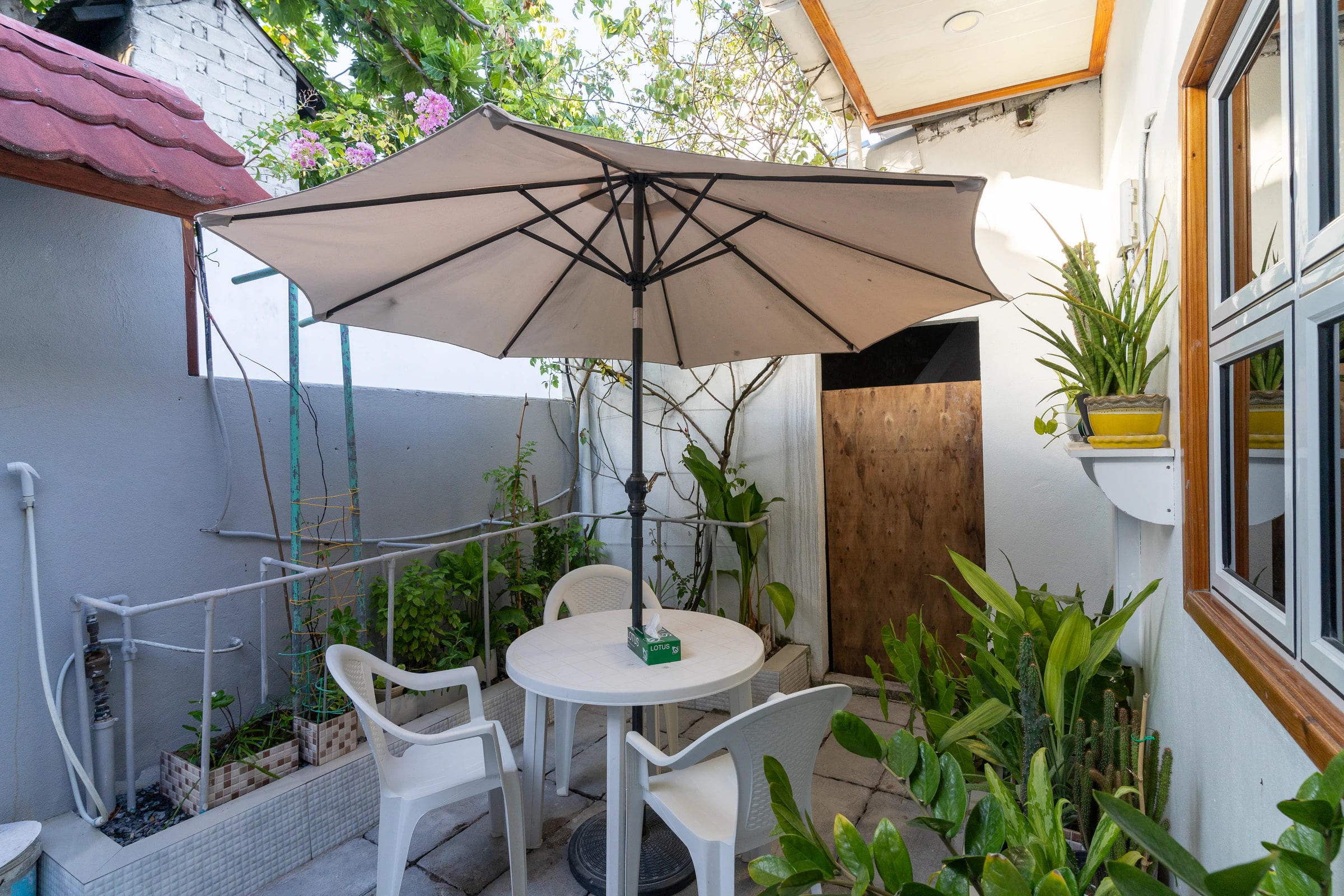
That is the honest answer rather than a photograph of a desk. The dining table is the working surface, in an air-conditioned living and dining area separate from both bedrooms, and the courtyard has a table, chairs and an umbrella opening off it. Power sockets are available throughout: both bedrooms, the living area and the kitchen.
On noise, which decides whether you can take calls: the house is quiet and the air conditioning is usually the loudest thing in it. You will hear the call to prayer from the island's mosque five times a day. That is part of being somewhere people live, and it is worth knowing in advance rather than discovering it mid-meeting.
If two of you both need to take calls at the same time, plan for it. There is one living area, and the second person will be working from a bedroom.
What about power?
Outages are very rare. Planned work is announced in advance and carried out during the day, and unannounced interruptions are very rare.
Maldivian mains supply is 230 volts at 50 Hz, and the British Type G plug is the most common, with types C and D also in use. Bring a Type G adapter and check that your chargers accept 230 volts, which nearly all laptop and phone chargers do.
Are you allowed to work remotely on a tourist visa?
The honest answer is that the official position does not address it, and you should treat that as an open question rather than a yes.
The Maldives has no digital-nomad or remote-work visa. Its published visa categories cover tourism, business, employment, residence and family, and nothing in the tourist framework speaks to working remotely for an employer outside the country, in either direction. That silence is not permission and it is not a prohibition.
If your circumstances depend on the answer, ask Maldives Immigration directly rather than relying on any travel page, this one included. For what a stay of 30 to 90 days actually requires — the documentation, the extension process, and what can and cannot be promised — our guide to planning a 30 to 90 day stay covers it properly, and Maafolhey helps long-stay guests with the extension process where required.
What does the island's week do to yours?
It shifts by two days, and this is the detail that catches people out.
The Maldivian working week runs Sunday to Thursday. Friday and Saturday are the weekend, and Friday is the congregational prayer day. So your Monday is the island's second working day, your Friday is its weekend, and anything requiring an office is a Sunday-to-Thursday, morning errand.
In practice for a working month: shops and restaurants may close roughly between 11am and 1:30pm on Fridays. With a kitchen this is a non-event. It also means your quietest working day and the island's quietest morning are the same day, which some people find ideal.
Who should not plan a working month here?
Several kinds of people, and it is cheaper to find out now.
Anyone with a synchronous US Pacific team. The overlap does not exist.
Anyone who needs to move very large files daily. The upgraded line handles a great deal, but a video editor pushing hundreds of gigabytes to the cloud every day should think carefully.
Anyone who wants a bar after work. Alcohol is not available on inhabited local islands, and this is a legal position rather than a matter of local preference. If a drink at the end of the day is part of how you unwind, this is not the place.
Anyone who needs a city. This is a small island of a few hundred people. There is no coworking space, no nightlife and no crowd. Over a month that is either the entire point or a slow problem, and only you know which.
It is also worth knowing that Maldivian law criminalises same-sex relations, which is a serious consideration for some travellers and is not something this or any accommodation can change.
If a working month here fits
The case for it is narrow and specific. A European working day that starts at midday and leaves the morning genuinely free, a connection you can plan against because both numbers are published, a kitchen so meals are not a daily logistics problem, a house where nobody else's holiday is disturbed by your evening calls, and an island small enough that nothing takes long.
If your plans are closer to a fortnight than a month, our guide to trip length is the better starting point, and the month-plus island guide covers choosing where to base yourself. For what the non-working part of a long stay is actually like, an ordinary week here covers the days off, the shopping rhythm and the week the novelty wears off.
If that describes what you are looking for, see the long-stay options, and send your dates and what your work actually needs. Tell us if you need the upgraded connection and we will arrange it before you arrive.