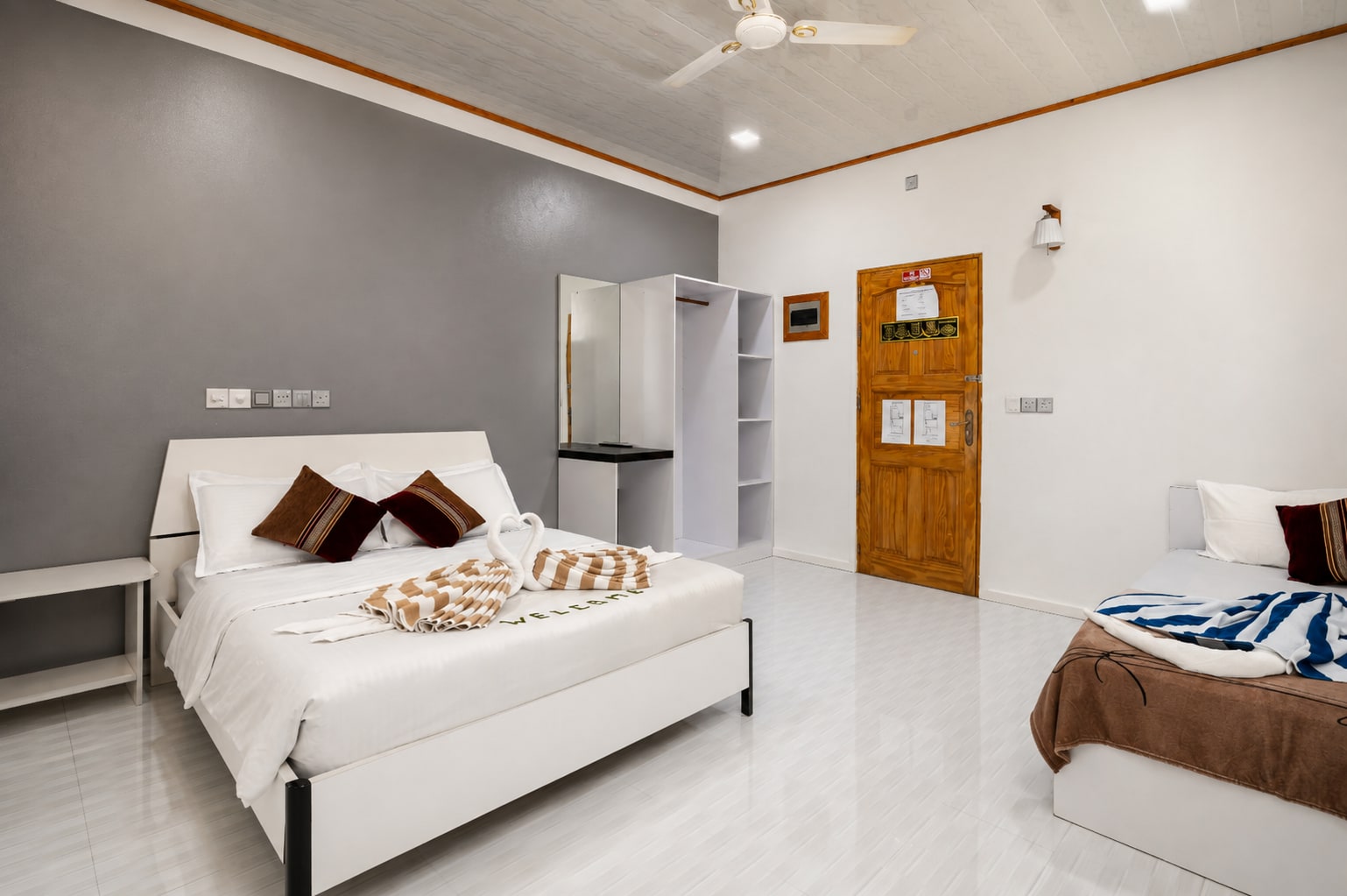
A family staying in the Maldives for three weeks has a different accommodation problem from a couple visiting for four nights. Depending on the property and its occupancy rules, a family of four or five may need more than one room. Over a fortnight or more that creates a cost question and a daily-living question at the same time.
Renting one entire home can address both problems at once. Here is how the comparison works and what to check before committing either way.
The multiple-room problem gets worse every week
For a short trip, booking two rooms is an annoyance. For a long stay it is a structural cost and a daily friction.
Take a simple example with stated assumptions: if a family would otherwise book two rooms at USD 80 each, that is USD 160 per night. Over 30 nights, USD 4,800. Over 60 nights, USD 9,600, because you keep paying for the second room for as long as you stay. (These rates are illustrative assumptions for the arithmetic, not quoted market averages.)
The friction is less obvious but just as real. Separate rooms can make meals, bedtime and morning routines harder to run together, and depending on the room type there may be little shared space to sit together outside the beds. Over weeks, having a common area where the family can eat at a table, spend an evening and spread out during the day makes a noticeable difference.
What a whole-home booking changes
Renting one entire property can collapse both problems into a single decision. Everyone stays under one roof because the whole place is yours: one booking, one price for the family, one arrival plan.
Maafolhey, a private holiday home on Ukulhas island, is rented exactly this way, to one booking group at a time. Two bedrooms, a living and dining area, a private kitchen and a washing machine, sleeping up to six guests. Both bedrooms are part of the same private booking; the property is never shared with other guests. No breakfast or meal plan is included: guests cook in the private kitchen or eat at island restaurants as they choose.
Two bedrooms allow separate sleeping arrangements where appropriate: parents and children in different rooms, or grandparents with their own space. How your group actually divides the bedrooms is up to you, which is part of what makes a whole home flexible for families of different shapes. The living area then becomes the shared space where a long stay happens: meals at the table, time together in the evening, and room to spread out during the day.
Feeding a family for weeks: the kitchen question
Meals are one of the biggest practical differences between accommodation types over a long stay.
With kitchen access, breakfast happens on your schedule and children can eat familiar food without negotiating a menu each time. Without it, most meals happen in restaurants by default.
On Ukulhas the practical pattern is a mix: island shops cover groceries, local restaurants cover the evenings you do not cook, and the house kitchen covers the rest. Whether self-catering lowers your total spending depends on how your family eats, what ingredients cost during your stay and how often you eat out. If saving money matters to you, compare realistic grocery-plus-occasional-restaurant costs against full restaurant days before you book, rather than assuming either direction.
A related benefit is laundry. With a washing machine in the property, a month-long family trip does not require packing a month of clothes. Pack for about a week and wash as you go, which with children usually means fairly often.
How Maafolhey's seasonal rates affect a longer family stay
Maafolhey's complete seasonal structure for the entire home is:
- USD 150 per night: May, June, July, September
- USD 250 per night: April, August, October, November
- USD 400 per night: December, January, February, March
- USD 600 per night: festive override, 24 December through 5 January
Each nightly rate includes the 10% service charge and 17% TGST; Green Tax (USD 6 per taxable guest per night) and scheduled speedboat transfers are separate.
At the July rate of USD 150 per night, seven nights come to USD 1,050 as an accommodation subtotal for the entire home, service charge and TGST included, before any qualifying offer. For longer stays, Maafolhey publishes four exact-length direct-stay offers: Stay 7 · Pay 6, Stay 10 · Pay 8, Stay 14 · Pay 11 and Stay 21 · Pay 17. Each applies to a stay of exactly that length; other stay lengths do not automatically attract a discount, so ask about current terms for your exact dates.
If you are comparing against conventional rooms over the same period, run the arithmetic with real quotes for your dates. What matters is comparing totals for the whole group, including taxes and transfers, not nightly headline prices.
What to confirm before booking any long family stay
Whichever property you choose, put these questions to the host in writing before committing:
- Is the entire property ours alone, or are spaces shared with other guests?
- How many guests does it sleep, and in how many separate bedrooms?
- Is there a working kitchen, and what equipment comes with it?
- Is there a washing machine guests can use themselves?
- How far are shops and restaurants from the property?
- What exactly does the nightly rate include? Which taxes, and which extras?
These six questions let you compare properties on the things that matter most for a long family stay: exclusivity, sleeping capacity, cooking and laundry facilities, nearby services and what the rate actually covers. Written answers also give you something to refer back to if anything differs on arrival.
Where Maafolhey fits
For families planning several weeks or more in the Maldives, Maafolhey is one option built around this comparison: an entire two-bedroom home rented to one booking group at a time, priced per home rather than per person, with a private kitchen, a living and dining area and a washing machine. No meal plan is included; you cook in the house or eat at island restaurants as you choose.
Send your dates and family size via WhatsApp to check availability and discuss whether the house fits your group.