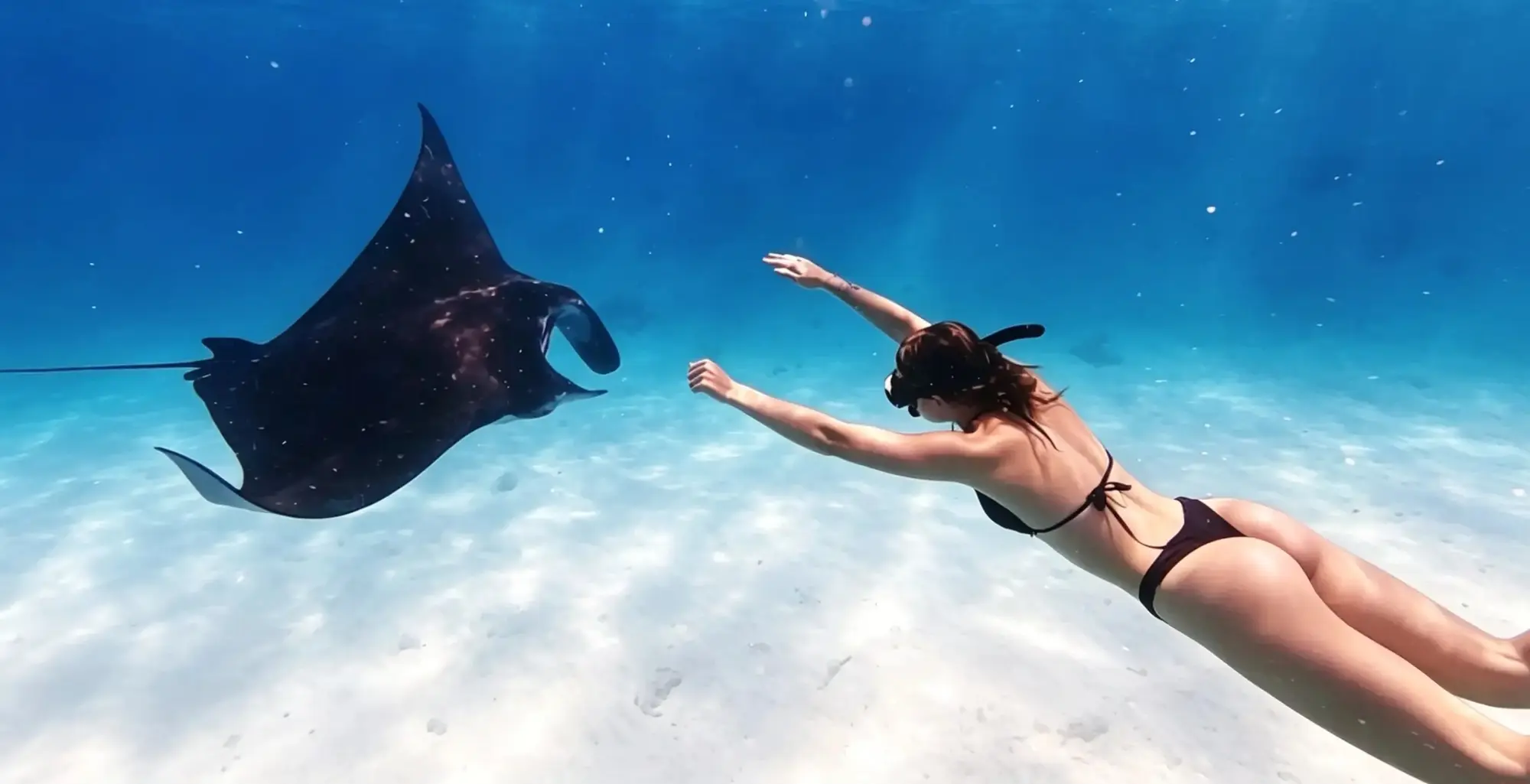
Six people book one trip. Two want two-tank mornings on the atoll edge. One is a freediver who needs depth, a line and someone whose only job is watching them. One is shooting macro and wants to spend forty minutes on a square metre of reef. Two are not going in the water at all.
That is a normal group, and almost nothing written about the Maldives helps you plan it. The dive-travel industry sells packages that assume everyone wants the same dive. This guide is about the harder question: how do you plan one trip when people in the same group want different things underwater, and how do you check that what you are booking is what you think it is?
This covers recreational and creative work. If your group is in the water to collect data rather than to dive, planning a marine biology field trip covers the permits, customs and workspace questions that come with it instead.
Throughout, scuba diving, freediving and underwater photography are treated as three distinct activities rather than as "diving". They have different equipment, different risks and different days, and collapsing them is where mixed-group trips go wrong.
Why can't these activities share one itinerary?
Because each one wants a different boat day, and a boat can only do one at a time.
Scuba runs on the operator's structure, whatever that structure is. To take one example of how it constrains a shared day: a centre running a two-tank morning departure with a fixed turnaround, because it wants the boat back for later trips, has very little room to accommodate anyone whose activity takes longer or starts elsewhere. That structure is efficient and it is not negotiable on a shared trip. It also means guided drift profiles chosen by the guide, and it constrains how far the boat will travel, since distant sites do not fit a schedule with three departures in it.
Freediving wants close to the opposite. A line session needs the boat to sit still over deep water, for a duration set by the group's recovery rather than by a timetable. And it needs dedicated surface supervision. Writing in DAN's Alert Diver, freediving instructor Chris Bustad puts the standard plainly: never freedive alone, and freedivers need to have eyes on each other on every dive and be close enough to intervene if needed. A lookout on the boat is not the same thing. That is a person committed to one job for the whole session, which a scuba boat's crew is not.
Underwater photography wants the longest possible time on one site, and often the site a scuba guide would rate lowest — shallow, macro-rich, good light. The photographer's enemy is the group's pace. They will fall behind, and a guide who does not expect that becomes a problem for everyone.
There is also a sequencing question that a mixed group must not improvise. On whether freediving after scuba carries added risk, the published expert view is genuinely unsettled: in Alert Diver, Robert Wong writes that breath-hold diving after scuba may increase the risk of decompression sickness but that the evidence is scarce, while Neal Pollock writes that compressed-gas diving prior to freediving certainly increases the theoretical risk. The same article concludes the risk remains very small. Note that the two experts do not give the same surface-interval guidance, and no source we found states a number of hours to wait after scuba before freediving. Do not let anyone invent one. Because the evidence is unsettled, this is not something to resolve from a travel page. Agree the sequencing and any surface intervals with a qualified instructor and your dive centre before the trip, and treat anyone offering you a confident number with caution.
Do you need one operator, or several?
Ask it directly, because the answer changes the whole shape of the trip.
Sometimes one centre can support a mixed day. Some local-island operators run a genuinely varied programme, and at least one on Ukulhas publishes underwater photography as its own dive type, with slower profiles, patient guides and sites picked for light and macro life. That is a meaningfully different offer from a standard fun dive and it tells you the centre has thought about photographers.
Often, though, the activities need separate bookings. A freediving line session and a two-tank scuba morning are not the same charter. If your group wants both on the same day, you are asking one boat to be in two places.
The question that resolves most of this is whether the operator will run a private or exclusive charter for your group, and on what terms. A group of four to six is close to a whole boat already: local-island charter boats are commonly in the twenty-seven to thirty-five foot range taking five or six passengers, and dive centres frequently cap guided groups at four divers per guide. Chartering converts the day from something you accept into something you specify. Not every centre publishes this option, so you will usually have to ask.
Two more questions worth putting in the same message: whether your group's dives aggregate for pricing, since fun-dive pricing is often a per-diver cumulative ladder and six people diving ten times each is not obviously sixty dives; and what the non-divers do, because on a small island the same boat and crew often run snorkelling and island trips, which solves the problem elegantly but only if the boat is not already committed.
Freediving in Ukulhas: what is and is not available
This needs stating carefully, because two different things get conflated and the difference matters for safety.
Excursion operators on Ukulhas will take freedivers out. That is confirmed and it is a real service.
What we could not find, searching in August and September 2026, is any published freediving instruction on the island. Provider listings change, so re-check rather than treating this as permanent. At the time of searching, across the major agencies: AIDA's instructor directory filtered to the Maldives returned no results, with the filter proven working on other countries. SSI lists dozens of training centres in the Maldives and twenty-eight offering freediving, none of them on Ukulhas; the only one in this atoll is on Rasdhoo. PADI's Maldives locator filtered to its Freediver course returns fifteen centres, again none on Ukulhas, with the nearest in the atoll also on Rasdhoo. The island's own destination directory contains no freediving mention anywhere on the site. One agency's instructor map could not be checked at all, so treat that as unknown rather than as evidence.
A boat that takes you freediving is not a freediving course, and it is not safety cover. If your group includes an instructor bringing their own students, or anyone who wants supervised depth training, you should assume you are bringing the instruction, the line, the buoy and the safety diver with you, and you must confirm directly with the operator what they will and will not do. Do not read "we take freedivers" as "we will supervise your depth session".
A visiting instructor teaching their own students at a third-party location also raises agency, insurance and liability questions that we could not resolve from published sources and that are not ours to answer. Settle those with your agency before you book anything.
How do you verify a dive operator properly?
With the government's own register, which almost nobody tells travellers exists.
The Ministry of Tourism maintains a public register of registered dive centres, downloadable, listing several hundred centres nationally with the atoll and island for each. You can look up any centre you are considering and confirm it holds a current registration. For an organiser committing a group and a deposit to an operator found through a search result, that is a far stronger check than reviews.
One thing to understand before you use it, or you will misread the result. A centre's public trading name is frequently not its registered name. On Ukulhas, for example, the register lists an operator called Scuba Journey, which trades publicly as Dive Club Ukulhas. Search for the brand and you find nothing; search for the licensed entity and it is there.
So a nil result is a question, not a verdict. Ask the operator which name they are registered under, then check that. A legitimate business will answer this immediately and without irritation, and the answer itself tells you something about how they run.
The rest of the vetting is the same discipline whether you are diving for a week or for a month, and our diving guide sets it out: current credentials, how sites are matched to certification and recent experience, what is included and what is charged separately, how weather and site changes are communicated, and cancellation and insurance terms.
Two further checks specific to a group. Ask whether nitrox fills are actually available rather than whether a nitrox course is offered, because those are different things and only the first affects your dive plan. Several Ukulhas centres offered fills as at September 2026; confirm current provision with the centre you book. And ask what the operator's position is on local depth and decompression rules, which exist in Maldivian regulation but are published only in Dhivehi and which we are not going to paraphrase from a machine translation. Your operator works under them daily. Ask them.
What do underwater photographers need that nobody plans for?
Time, space and power, in that order, and the space is the one accommodation decides.
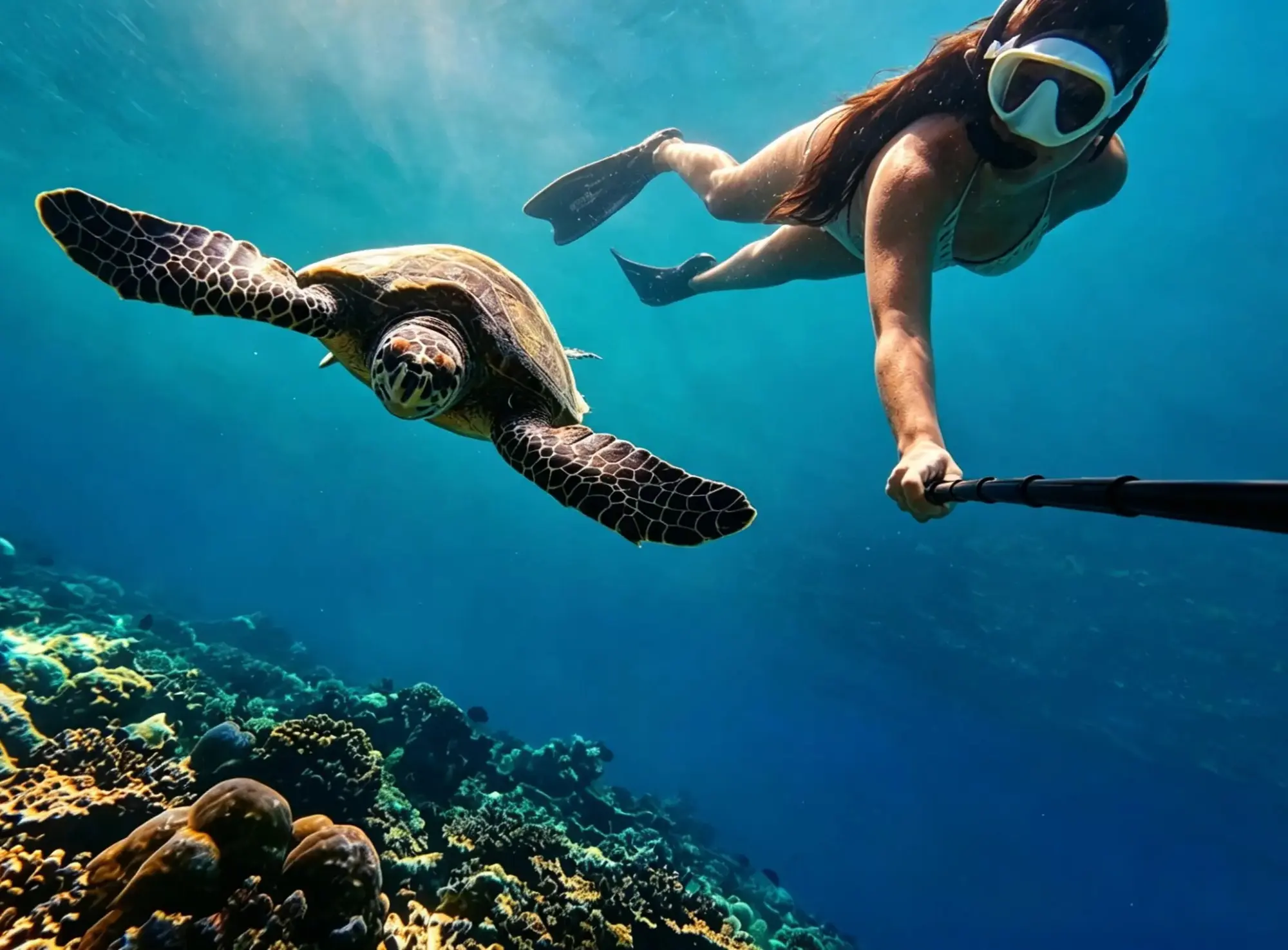
Camera care is a daily job, not a habit. The standard guidance from the underwater photography community is to soak the housing in fresh water after every salt-water dive, and to clean and re-lubricate the housing, port and strobe o-rings after every dive day. The most-cited cause of flooding is a desiccant pack or a hair caught in an o-ring, and the strong advice is that this work must be done unhurried, in a calm, uncramped, well-lit place. A rushed rig assembly on a moving boat is how expensive housings flood.
That is why the workspace matters more than it sounds. A photographer needs a table, out of wind and sand, with light and a power socket, for an hour a day, without displacing everyone's dinner. It is a cost-avoidance feature rather than a comfort.
Rinse discipline. Photographers generally refuse shared rinse tanks, and "it flooded in the rinse tank" is the sector's stock horror story. Ask whether a camera can be rinsed separately from general gear and left somewhere undisturbed. Never leave a housing in direct sun, which causes fogging.
Power. A four-photographer group runs chargers for camera batteries, strobes, video lights, laptops and dive computers at once. Maldives mains is 230 volts at 50 Hz with the British Type G plug most common, so check your chargers accept 230 volts and bring a Type G adapter and a surge-protected strip.
Batteries in the air. Spare lithium batteries travel in carry-on only, with a general limit of 100 watt-hours per battery, and larger 101 to 160 Wh packs — which covers some video light batteries — permitted only with airline approval and usually capped at two. Airlines and individual legs frequently impose stricter rules than the headline ones, and we could not verify carrier policies to Malé or any domestic-leg rules, so confirm with every carrier on your itinerary rather than assuming.
Data. Working shooters back up to local drives, not to the cloud, and on a local island that is the right instinct. At Maafolhey the standard connection is around 5 Mbps download and 2 Mbps upload; guests who need more can ask and it is upgraded to around 50 Mbps down and 20 Mbps up at no additional charge. Even then, carry drives and treat any sync as a convenience. Our remote-work guide works through what each figure supports.
Planning the last two days
Backwards from your flight, and this is where mixed groups make their most dangerous mistake.
DAN's flying-after-diving guidance recommends a minimum preflight surface interval of 12 hours after a single no-decompression dive, and a minimum of 18 hours after multiple dives in a day or multiple days of diving, which describes nearly every group trip. DAN states plainly that these recommendations reduce risk but do not guarantee avoidance of decompression sickness.
The Maldives-specific part that catches people: those 18 hours have to absorb the transfer as well. From Ukulhas that means allowing around 90 minutes for the scheduled speedboat to Velana International Airport, plus check-in, plus a departure that is frequently late at night. Count backwards from the flight, not forwards from the last dive.
On chambers, the tourism ministry publishes a list of hyperbaric treatment facilities and the nearest to this atoll appears on it. That list carries an old date, publishes nothing about operating status, and a chamber existing on a resort island is not the same as it being staffed and accessible to a non-guest on the day you need it. Do not treat a published list as cover. Carry proper dive insurance and agree an evacuation plan with your operator before the first dive; that plan is your actual safety asset.
What does the group need from the accommodation?
Less than you might think, and one thing more than most properties provide.
The genuinely important item is somewhere the whole group can work and plan together: a table indoors, in air conditioning, with power, that is not also someone's bedroom. Rig assembly, o-ring maintenance, card offloading, tomorrow's plan and the argument about whether to charter all happen there.
Beyond that: charging capacity spread through the house, somewhere lockable for expensive camera systems while everyone is on the water, a way to wash and dry salt-soaked clothing, and a kitchen usable at any hour, because boats leave before service hours and come back at unpredictable ones.
At Maafolhey that is an air-conditioned living and dining area separate from both bedrooms, a dining table, power sockets in both bedrooms, the living area and the kitchen, a house that locks as a whole with the group holding the keys, a washing machine with a portable hanger that wheels into the courtyard, an outdoor tap for rinsing, and a kitchen with a stove, oven and freezer. It sleeps six across two bedrooms, with the sixth on the living-room sofa or an extra mattress, which for a group of six is worth thinking about honestly before booking.
What it does not have: a camera room, a dedicated rinse tank, drying racks, or any equipment facility. It is a house, and for a group of four to six that turns out to be enough, but you should know what you are getting. For what accommodation matters over a longer scuba stay, the diving guide linked above covers it; for the island itself, read more about Ukulhas.
If a whole home suits your group, see what it contains, then send your dates, group size and what each of you is planning to do in the water.