Search for Ukulhas with children and you will find lists of things to do. Attractions, excursions, top tens. What you will not find anywhere is an account of an ordinary day, which is the thing you actually need if you are bringing a three-year-old here for a fortnight.
So this is a day. Not the best day, not a highlight reel, and with the parts that are harder than a resort left in.
If you are still choosing between islands, our guide to what decides a longer family stay comes first. If you have not settled the accommodation question, the guide to a fortnight with young children covers it.
What happens in the morning?
If your children wake early, that works in your favour here.
Early morning is the best part of the day. The heat has not arrived, the light is good, and the island is at its most active. Ukulhas is about one kilometre long and everything is on foot, so a morning does not require planning. The nearest beach, on the sunrise side, is about a minute's walk along the main lane. If your children want water before breakfast, they can have it and be back before anyone has decided what to eat.
Breakfast then happens on your schedule rather than a serving window, which is the single biggest practical difference between a house and a room when small children are involved. There is no queue, no set time, and nothing to negotiate with a child who wants the same thing every morning.
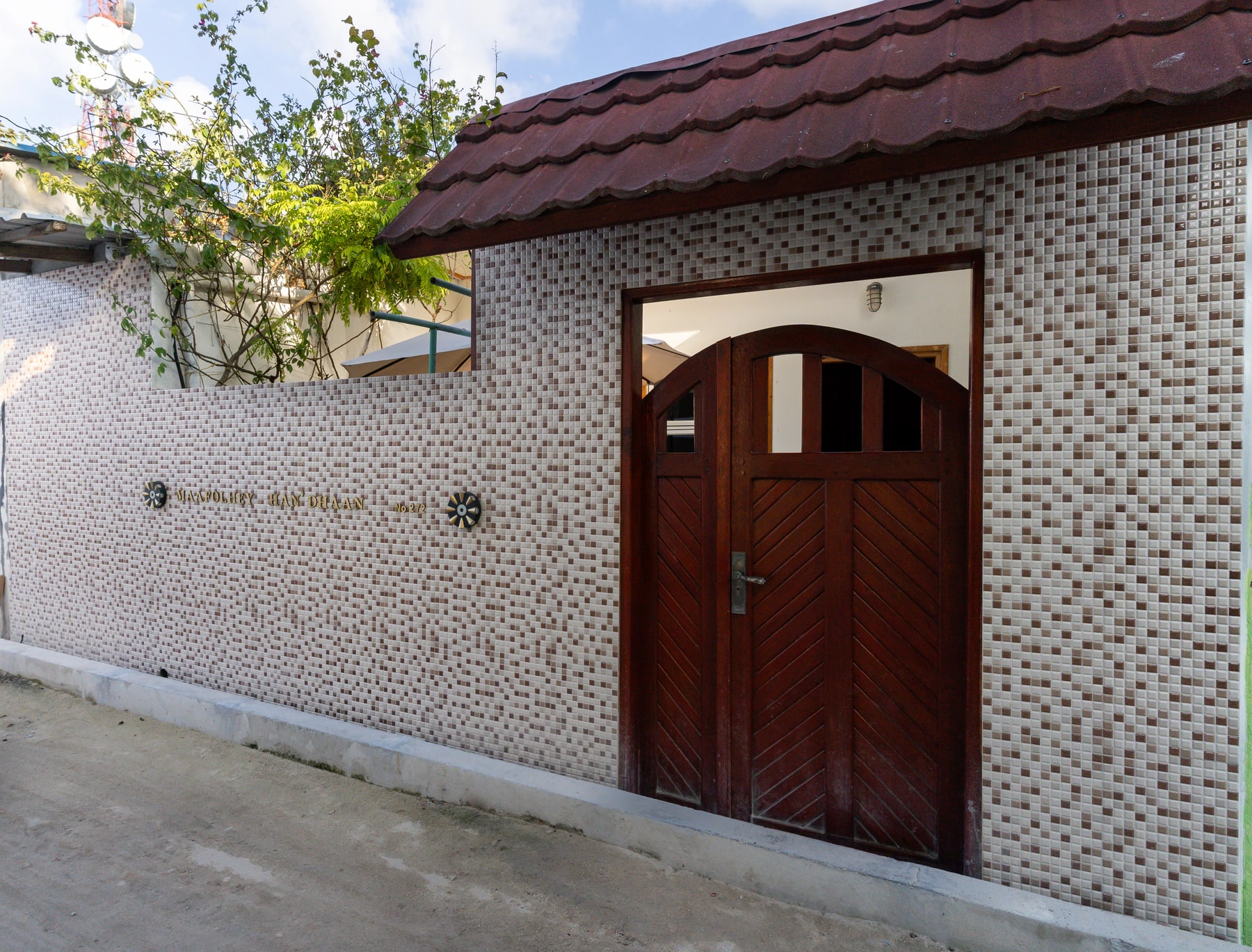
The designated bikini beach, which is where swimwear is worn, is about five minutes away, two lanes over. That walk is short enough to do twice in a day without it becoming an expedition. Most families bring a pushchair. Maafolhey does not provide one, but the main door takes one easily and it lives in the living room between outings.
Where do children actually swim, and how safe is it?
At the shoreline, and safely, with one important caveat that nobody else will tell you.
There is no lifeguard service on Ukulhas. Nobody is watching your children but you. That is true of local islands generally, and you should discount any page that suggests otherwise.
With that understood, the water itself is well suited to small children. At the shoreline it is shallow and calm, and children can play in it, except in rough weather and at high tide. It deepens as you go out, reaching roughly four to ten metres over the house reef, so the transition from paddling to real depth is something to keep an eye on rather than something that happens suddenly at your feet.
There is shade at the designated beach area from low bushes and small trees, which matters more than it sounds. A beach with no shade is a beach you leave after forty minutes. Beach towels are provided at the house. Beach chairs are not, so bring or borrow if you want one.
What do you feed them?
Mostly what you brought or cooked, with restaurants filling the gaps.
Island shops reliably stock nappies and wipes along with all the major everyday items. Formula and baby food are the things to bring with you. The rhythm behind the shelves is worth knowing: supplies reach the island by boat roughly twice a week, so what is available moves through the week. If your child eats one specific thing, bring it rather than plan on finding it.
Restaurants on Ukulhas are set up for adults. Some will cook plain food for a child and some will not, and it genuinely depends on the place. Some have high chairs. The useful thing, which took a local to tell us rather than a review site, is that most will help if you bring something of your own for a baby or small child and ask them to boil or heat it. That single arrangement solves a lot of evenings.
For how the shopping and cooking side actually works over a longer stay, the self-catering guide covers it properly.
Where can children go, and who do they play with?
More freely than most families expect, and often alongside the island's own children.
Local children commonly move around the island independently, and visiting families often find their children have more freedom here than at home. That is an observation rather than a guarantee: it is a working island with lanes, motorbikes and a harbour, and how closely you supervise your own children stays your decision. There is a children's park about a minute's walk from the house, which the island council describes as designed for children with adult supervision. It is not a tourist facility. It is the island's park, shared with local children, and visiting children commonly end up playing with them.
This is the part that surprises families most, and it is worth being clear about what it is and is not. It is not an activity, it is not arranged by anyone, and nobody can promise you it will happen on a given afternoon. It is simply what tends to happen on a small island where a few hundred people live and the children are outside. Some families find it the thing they remember; others keep to themselves, and that is fine too.
Guests move around the island the way residents do. There is no separate tourist zone here and no gate between you and everyday life.
What do you do between eleven and three?
You go inside, and this is where the accommodation earns its keep.
The middle of the day is hot, and with young children it is not beach time. On a short trip you absorb this. Over a fortnight it is four or five hours a day that need somewhere to be. At Maafolhey that is an air-conditioned living and dining area separate from both bedrooms, and a small courtyard with a table, chairs and an umbrella opening off it. A younger child can nap in a bedroom, or in the cot moved into the living room, while everyone else stays together.
Housekeeping runs throughout the stay, with cleaning and linen changes on request and routine housekeeping otherwise every three days, so the middle of the day is not spent tidying either.
The house is quiet. The air conditioning is usually the loudest thing in it. You will hear the call to prayer from the island's mosque five times a day, which is part of being somewhere people actually live rather than somewhere built for visitors.
What happens if a child gets ill?
There is a doctor on the island every day, and the health centre is open around the clock.
This is the question parents ask most often about local islands, and it is almost always answered with a line about travel insurance. The real answer for Ukulhas: the health centre operates 24 hours, with a doctor present daily and a pharmacy stocking basic medicines. For the ordinary things that happen with children at two in the morning, that is on the island rather than a boat ride away.
More serious cases may require referral or transfer off-island. That is the honest limit and you should factor it in. But "there is a doctor here today" is a materially different position from what most people assume about a small island, and it is worth knowing before you rule one out.
On mosquitoes: they are most noticeable during the rainy season, and the health centre runs periodic island fumigation in those months. Repellent, coils and insect spray are provided in the house.
What do children need to wear?
Less than you may have read.
There is no particular dress code for children on Ukulhas. Swimwear is for the designated bikini beach area, and that rule applies to everyone rather than being something extra asked of families. Around the village, ordinary clothes are ordinary clothes.
Adults should dress modestly away from the designated beach. That is the whole of it, and it is worth saying plainly because a great deal of writing about local islands makes this sound more complicated and more anxious than families find it in practice.
What is genuinely harder here than at a resort?
Several things, and pretending otherwise would be doing you no favours.
Nobody is looking after your children but you. No kids club, no supervised anything, no lifeguard. If what you want from this holiday is a few hours where someone else is responsible, a resort provides that and this does not.
Nobody cooks for you. There is a kitchen, not a meal plan. On the days you cannot face cooking, you walk to a restaurant that may or may not make something plain for a fussy child.
Fridays are different. Shops and restaurants may close roughly between 11am and 1:30pm for prayer. With a kitchen this is a non-event. Without one, it is the day you discover you should have planned lunch.
The island is busiest from December through March, which is also when the weather is at its driest and the rates are highest. Quieter months are quieter for a reason.
You cannot buy your way out of a problem. There is one health centre, a handful of shops, and a boat twice a week. Most of the time this is precisely what people come for. On the day your child needs something specific, it is a constraint.
Who is a fortnight here right for?
Families who want their children outdoors, in a real place, with the ordinary structure of a day intact.
If you want your children swimming before breakfast, eating what you cooked, playing in a park with local children in the late afternoon, and asleep in a house where nobody else's holiday is affected by them waking at two in the morning, that is what this is. If you want the day organised for you, it honestly is not.
Look inside the house, or read more about the island itself. When you are ready, send us your dates and the ages of your children and we will tell you plainly whether it suits your family.