A short trip with a small child is something most families can push through. The longer the stay, the less that works. As the days accumulate, a family stops visiting a place and starts living in it, and the things that were mildly awkward at the start can become the shape of the whole trip: where a baby sleeps, what a fussy child will eat, how much washing four people generate, and what the adults do between seven in the evening and bedtime.
None of that is about luxury. It is about whether the building lets a family behave normally. This guide covers what actually changes at that length of stay, and where a whole private home makes a difference that a room cannot.
If you have not settled the length yet, our guide to choosing between one week, two weeks and a month is the better place to start.
What does a two-week trip ask that a five-night trip does not?
Four things, and they compound rather than repeat.
Sleep stops being a one-off problem. A bad night on a short trip is survivable. Several in a row can change how everyone behaves for the rest of the trip.
Food stops being an event. Fourteen dinners out with a three-year-old is a different proposition from four.
Laundry becomes a system. Two weeks of clothes for a family of four, in a hot climate, with children, is not a packing problem you can solve at home.
The evenings become real. Once a child is asleep at seven, the adults have four hours. Where those hours happen decides whether the trip feels restful.
When the baby cries at 2am, what actually changes?
Nothing about the crying. Everything about who else is affected by it.
Picture the situation honestly, because nobody in it has done anything wrong. Your baby wakes at two in the morning. The baby is being a baby. You cannot simply stop it. Behind the next wall there may be another traveller who genuinely needs to sleep, and who may never say a word to you about it. A complaint may still reach reception in the morning, and the staff who receive it cannot really solve the situation either. Everyone has behaved reasonably, and the family still ends up feeling uncomfortable in the place they are paying to stay in.
In an entire private home, that particular pressure is simply absent. There is no other booking in the building. Parents can walk around with the baby, put a light on, warm a bottle, sit in the living room until the child settles, and deal with the night the way they would at home.
It is not only crying, either. A toddler wakes at five. A child wants milk at midnight. Someone is sick. A bottle needs sterilising. There is a tantrum. Older children play loudly while a younger one is asleep. One parent needs to move around the house after settling a child rather than sitting in the dark beside them.
For a family, privacy is not only about being unseen. It is also about having the freedom to behave like a normal family.
| Family situation | Guesthouse or hotel | Entire private home |
|---|---|---|
| Baby wakes crying at night | Parents may worry about neighbouring rooms | No unrelated guests share the house |
| Child wakes hungry | Depends on restaurant or service hours | Kitchen available at any hour |
| Energetic children | Mostly the room and shared common areas | Private living space and more room to move |
| Child sleeps early | Parents often stay in the same bedroom | Parents can use a separate living area |
| Laundry after spills and the beach | Depends on the property's service | Washing machine in the house |
To be clear about what this is not: guesthouses work perfectly well for a great many families, and plenty of them are excellent. The argument here is narrower. A whole home removes a handful of everyday frictions, and those frictions become far more noticeable over ten or fourteen nights than over four. If you want that comparison worked through properly, our guide to hotel rooms against a private holiday home does it question by question.
Where does everyone actually sleep?
At Maafolhey, in two bedrooms that between them take five people, with a sixth possible.
Bedroom one has one double bed and sleeps two. Bedroom two has one queen bed and one single, and sleeps three. Both are air-conditioned and each has its own bathroom. For a sixth guest, the living-room sofa sleeps one adult, or an extra mattress is available on request.
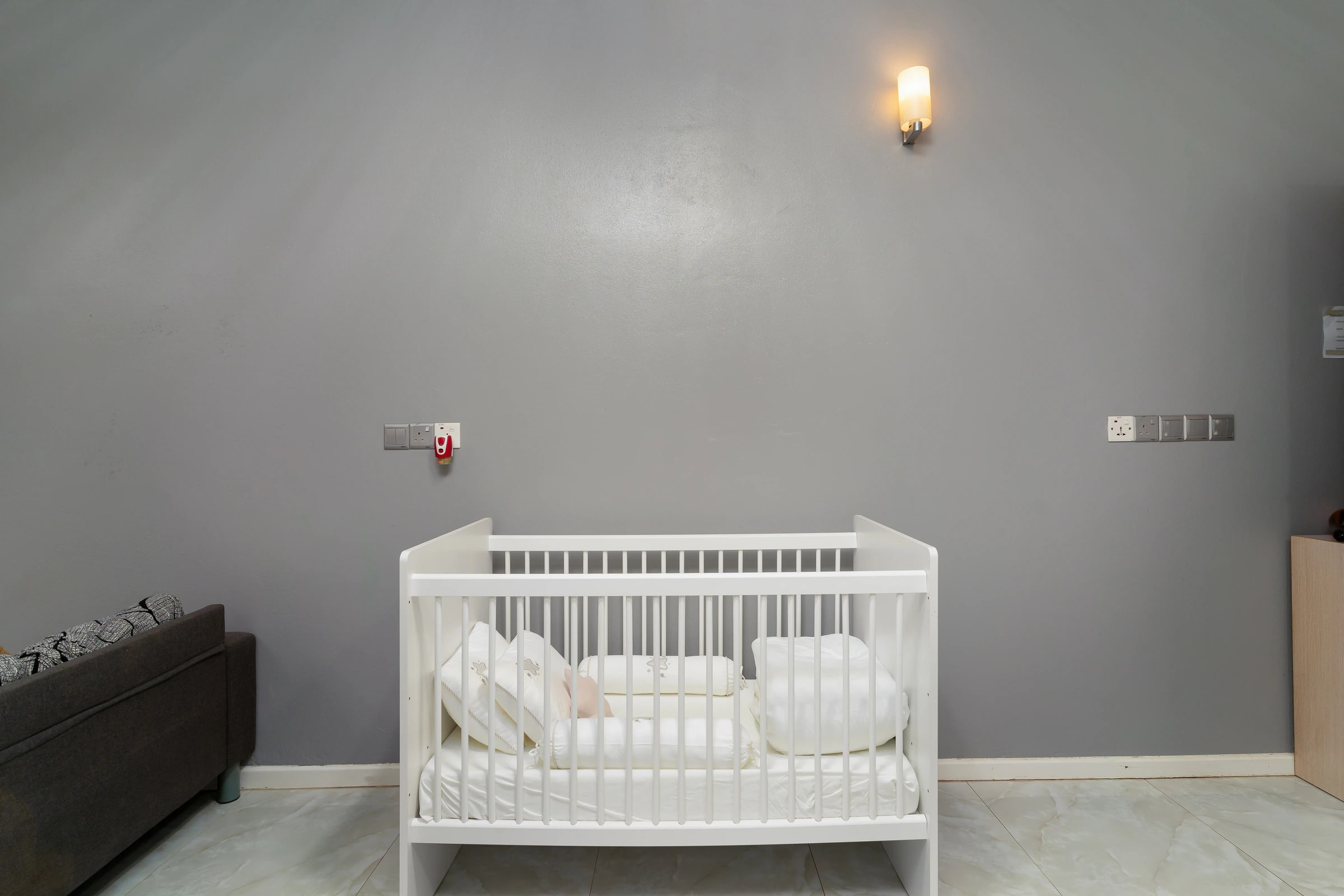
A cot is available, and this is the part worth knowing before you book: it fits in either bedroom with the door still closing. That means the room allocation is your decision rather than the building's. Parents and baby in one room with older children in the other, or grandparents with their own room, both work. The cot can also be moved into the living room during the day, so one parent can cook or sit with everyone else while the baby sleeps in sight.
If you are bringing a pushchair, most families do. Maafolhey does not provide one, but the main door takes one easily and it stores in the living room when it is not in use.
Can you feed a child who eats three things, for fourteen nights?
Yes, but the kitchen is doing most of the work, not the restaurants.
Children's menus, high chairs and plain-food options vary by restaurant. Some places on Ukulhas will cook plain food for a child and some will not. The more useful thing to know is that most will help if you bring something of your own for a baby or small child and ask them to boil or heat it.
That is a reasonable arrangement for a few evenings. It is a poor plan for fourteen. The kitchen at Maafolhey has a stove, an oven and a refrigerator with a freezer, which means breakfast happens on your schedule and a child who only eats pasta can eat pasta without a negotiation every night.
For supplies, the island shops reliably stock nappies and wipes, along with all the major everyday items. Formula and baby food are the things to bring with you. If a particular product matters to your child, bring it rather than plan around finding it.
The practical detail behind all of this is that supplies reach Ukulhas by boat roughly twice a week, so what is on the shelves moves through the week. Our guide to self-catering on Ukulhas covers how the shopping rhythm actually works.
What do parents do once the children are asleep?
They use a room the children are not sleeping in.
This is the quiet argument for a whole home and the one families tend to discover rather than plan for. Some resorts offer kids clubs or babysitting, which is one way to solve the evening. A guesthouse room usually does not solve it at all: once a child is asleep, the adults are often in the same room, in the dark, on their phones.
Maafolhey has a living and dining area, air-conditioned, separate from both bedrooms, and a small courtyard with a table and chairs opening off it. The house is quiet, and the air conditioning is usually the loudest thing in it. You will hear the call to prayer from the island's mosque five times a day, which is part of staying somewhere people actually live.
How much laundry does a fortnight with small children make?
Enough that it changes what you pack.
Sandy and salt-soaked clothing goes through the washing machine, and a portable clothes hanger in the living room wheels out to the courtyard to dry in the sun. Housekeeping runs throughout the stay, with cleaning and linen changes available on request and routine housekeeping otherwise every three days.
In practice this means packing for about a week rather than a fortnight, which with young children is the difference between one suitcase and two.
What does Ukulhas itself ask of a family?
Less than most parents expect, and two answers matter enough to give here.
There is no lifeguard service on Ukulhas. The water is shallow and calm at the shoreline and suitable for small children, except in rough weather and at high tide, but nobody is watching them but you.
The island's health centre operates 24 hours, with a doctor present daily and a pharmacy stocking basic medicines. More serious cases may require referral or transfer off-island. That is the honest position, and it is more than most local island pages will tell you.
Everything else about daily life here — the walk to each beach, the children's park, what a restaurant will cook for a child, mosquitoes and the seasons, and what an ordinary day actually looks like — belongs in our guide to a day on Ukulhas with children, which covers it properly rather than in summary.
What is charged separately, and which offers apply?
Rates are published per home per night by season and include the 10% service charge and 17% TGST. Green Tax is separate, at USD 6 per taxable guest per night, and children under two at check-in are exempt from it. Scheduled speedboat transfers are separate and priced by age: infants are 0 to 2 years, children 3 to 10, and guests aged 11 and over count as adults.
For stays of exactly ten or fourteen nights there are two direct offers, Stay 10 and Pay 8, and Stay 14 and Pay 11. They apply at those exact lengths rather than as a general discount.
If you want the arithmetic for a whole household rather than a nightly rate, our guide to long-stay costs for four to six people works it through with the assumptions stated. If your trip is closer to several weeks or months than a fortnight, the family long-stay guide is the one that covers it.
When is a whole home the wrong choice?
When you want the trip handled for you.
A private home gives you a kitchen, but nobody cooks in it for you. There is no kids club, no babysitting, no meal plan and no restaurant downstairs. If what your family needs from this holiday is for meals and childcare to be someone else's problem, a resort does that well and a whole home does not do it at all.
It is also two bedrooms, not four. A group needing a room per adult will not fit. And beach towels are provided but beach chairs are not, which is the kind of small thing worth knowing before you arrive rather than after.
If the picture in this guide sounds like your family, look inside the house and its rooms, then send your dates and the ages of your children on WhatsApp and we will tell you honestly whether it fits.